Frieda and Gretel deported to unknown destination
Simon's letter fragment: 'Aunt Frieda and Gretel departed last Thursday to an unknown destination, along with many others.'
Correspondence (5 documents)
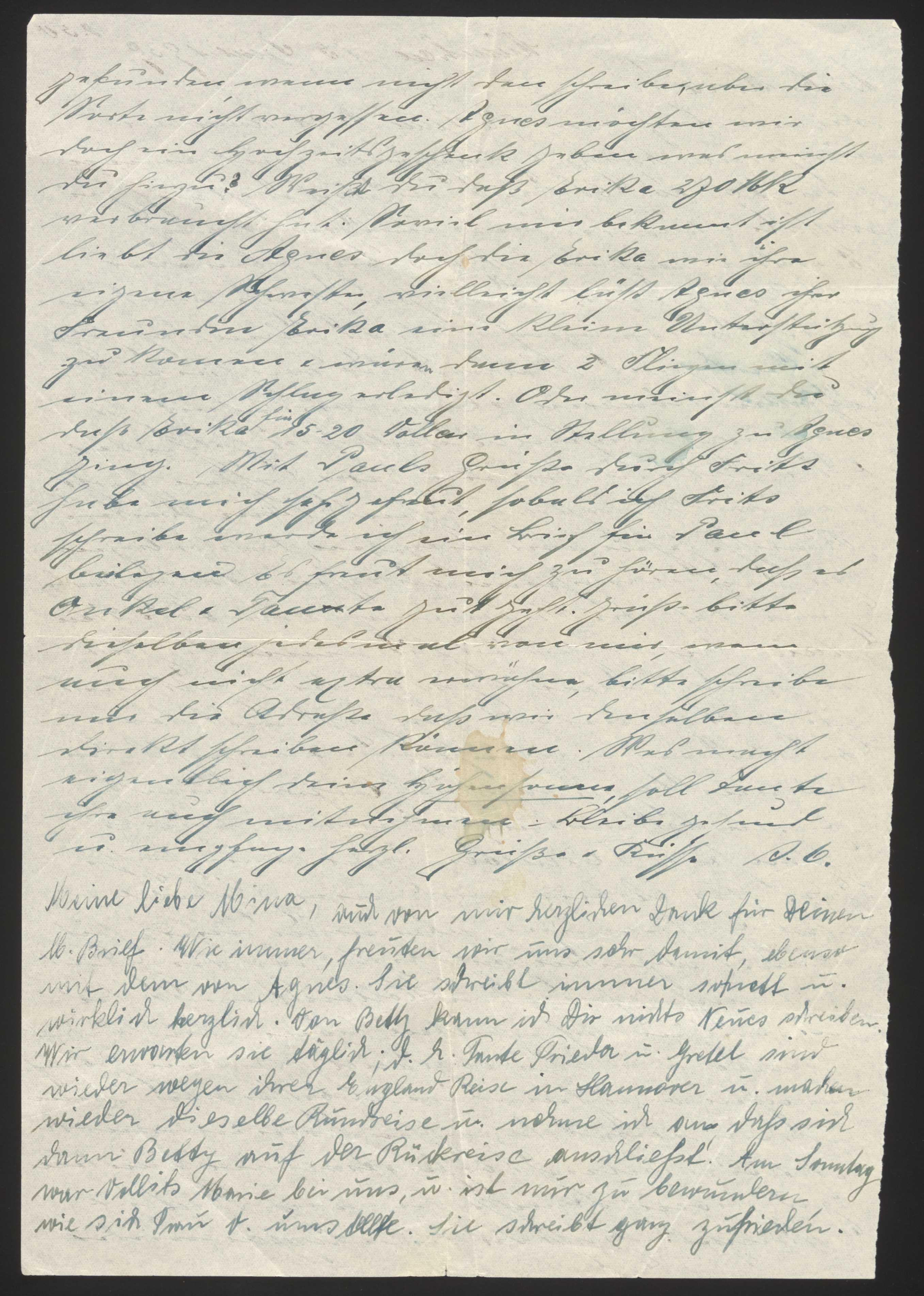
Handwritten letter (page 2 / continuation)
06.1930
Transcribed
[Top: continuation of previous letter — discusses writing, travel plans, and errands]
Greetings and kisses M.B. [?]
[Second note:]
My dear Mina, and from me also heartfelt thanks for your dear letter. As always, we are very [glad?]... The letters always arrive quickly and punctually. From Sally [news]... Remember Aunt Frieda and [try] again about the passport in Hannover and further... You should [?] reside in [?]... that Betty joins on the return journey. On Sunday, Roselie's [daughter/relative] Mane was with us, and [visited] in Semmering where she is very [happy]. She seems quite content.
[Top portion: continuation of letter from 0003]
geschrieben [?] muss [?] über [?] begeben die Woche [?] mit [?] nehmen ... [multiple lines in Kurrent] ...
Grüsse u. Küsse M.B. [?]
[Second note, different handwriting:]
Meine liebe Mina, und von mir herzlichen Dank für Deinen lb. Brief. Wir immer, sehen wir mir sehr [?], denn wir [?] um in [?] die Briefe immer schnell u. pünktlich begleich. Von Sally [?] es Dir nichts [?] drücken [?] ... errinnere [?] Tante Frieda u. [?] nur wieder wegen doch u. [?] Pass in Hannover u. weiter [?]. Du sollst Mundige [?] wohnen in [?] dass ein [?] Betty auf die Rückreise anschliesst. Am Sonntag war Roselies Mane bei uns, u. ist mir [?] in Semmerin mit sie sehr [?] v. [?] wohle. Sie steht ganz zufrieden.
This page contains the end of the letter from 0003 and an additional note from another family member (possibly Elsa Oppenheimer). The mention of passports and Hannover suggests early discussion of emigration logistics. Betty, Sally, Aunt Frieda, and Roselie are mentioned as family connections.
Handwritten letter with multiple notes from different family members
07.09.1941
Transcribed
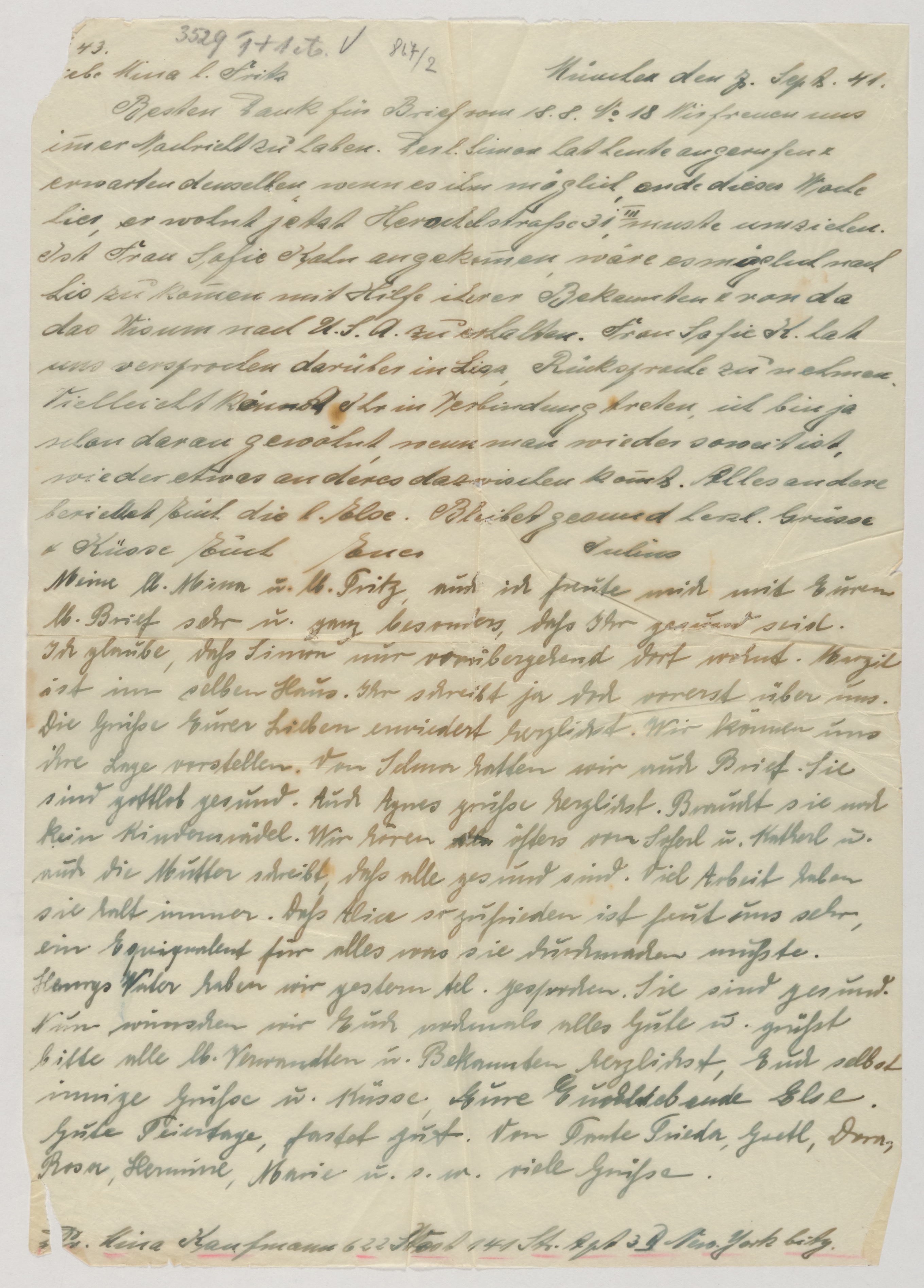
Munich, September 7, 1941
Dear Mina and dear people!
Greatest thanks for your dear [letter and package?]... [The letter discusses family news, mentions various relatives including Aunt Frieda, references to Christmas, and various personal updates. The writer (Julius) provides family news and greetings.]
Julius
[Second note — likely from Elsa or another family member, providing additional greetings and updates]
München den 7. Sept. [19]41
lb. Mina u. lb. Leute [?]
[First section:]
Grössten Dank für Euer liebes [?] u. P. [?] ... und Vergnügen Kriege u. Kalte [?] und liegt und höfisch [?] ... [?] wir letzten [?] Weihnachten [?] als das [?] den ...
[Multiple paragraphs in Kurrent, largely illegible — discusses family members, mentions of "Tante Frieda," financial matters, and various relatives]
Julius
[Second section — different hand:]
Meine liebe [?] Dein [?] Brief und [?] Ihren [?] ...
By September 1941, Jews in Munich were living under increasingly severe restrictions. The yellow star requirement (Judenstern) was implemented on September 19, 1941, just days after this letter was written. Communication with relatives in America was becoming nearly impossible. The systematic deportations from Munich would begin in November 1941.
Typed letter fragment
08.10.1941
Transcribed
[Top of page damaged/torn, text begins mid-sentence]
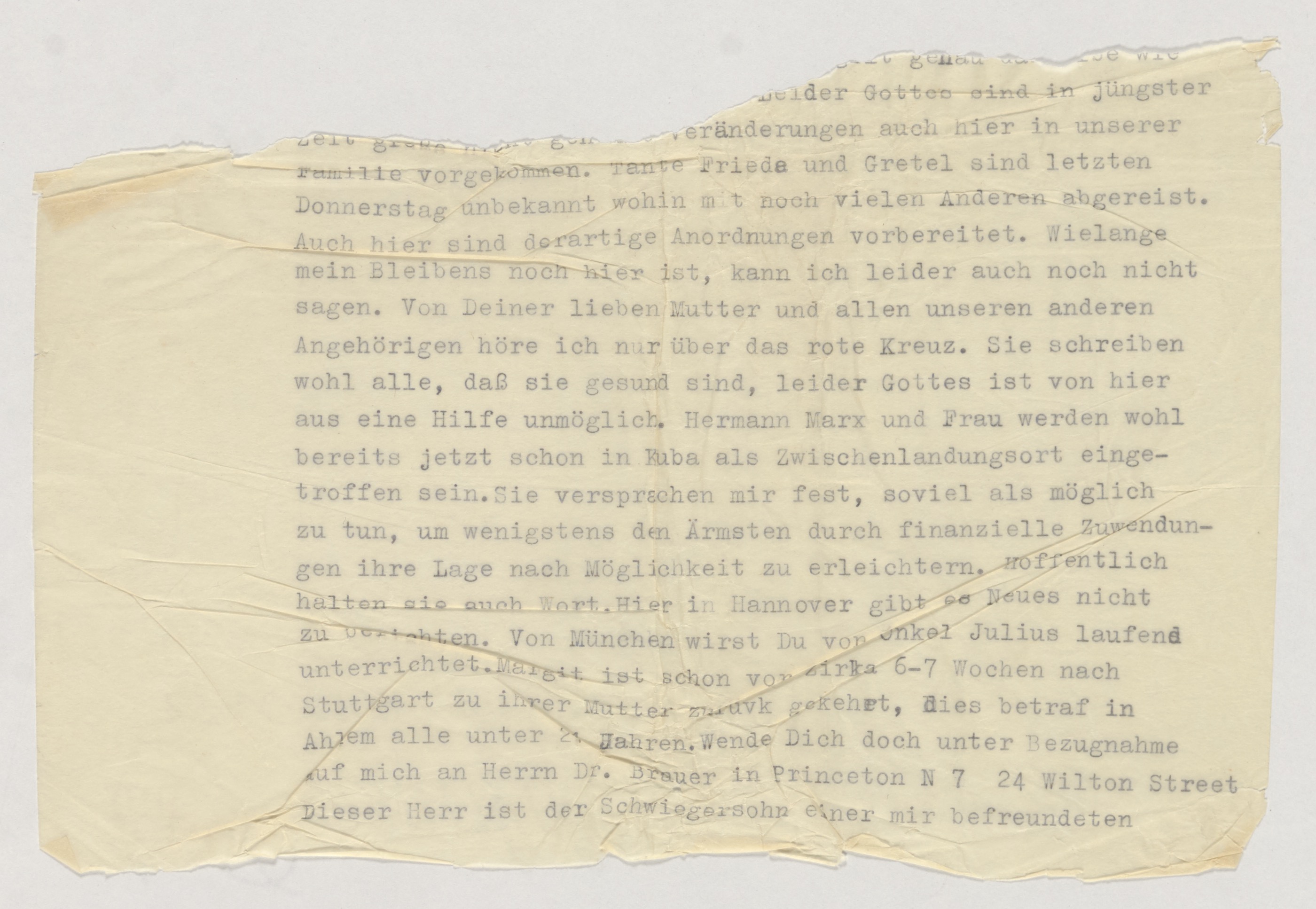
...unfortunately, God willing, in recent [times] ... changes have also occurred here in our family. Aunt Frieda and Gretel departed last Thursday to an unknown destination, along with many others. Such arrangements are also being prepared here. How long I will remain here, I unfortunately cannot yet say. From your dear mother and all our other relatives, I hear only through the Red Cross. They all write that they are well; unfortunately, from here any help is impossible. Hermann Marx and his wife will probably have already arrived in Cuba as an intermediate stop by now. They firmly promised me to do as much as possible to at least ease the situation of the poorest through financial contributions. Hopefully they will keep their word. Here in Hannover there is nothing new to report. From Munich you will be kept up to date by Uncle Julius. Margit already returned about 6–7 weeks ago to Stuttgart to her mother; all of this was under the old [arrangements]. Please contact, with reference to me, Dr. Breuer in Princeton, N.J., 24 Wilton Street. This gentleman is the son-in-law of a family I am friends with —
[Top of page damaged/torn, text begins mid-sentence]
...leider Gottes wird in jüngster [Zeit] ... Veränderungen auch hier in unserer Familie vorgekommen. Tante Frieda und Gretel sind letzten Donnerstag unbekannt wohin mit noch vielen anderen abgereist. Auch hier sind derartige Anordnungen vorbereitet. Solange mein Bleiben noch hier ist, kann ich leider auch noch nicht sagen. Von Deiner lieben Mutter und allen unseren anderen Angehörigen höre ich nur über das Rote Kreuz. Sie schreiben wohl alle, dass sie gesund sind, leider Gottes ist von hier aus eine Hilfe unmöglich. Hermann Marx und Frau werden wohl bereits jetzt schon in Kuba als Zwischenlandungsort eingetroffen sein. Sie versprachen mir fest, soviel als möglich zu tun, um wenigstens den Ärmsten durch finanzielle Zuwendungen ihre Lage nach Möglichkeit zu erleichtern. Hoffentlich halten sie auch Wort. Hier in Hannover gibt es Neues nicht zu berichten. Von München wirst Du von Onkel Julius laufend unterrichtet. Margit ist schon von circa 6–7 Wochen nach Stuttgart zu ihrer Mutter zurückgefahrt, dies betraf in Altem alles unter D. Nahren. Wende Dich doch unter Bezugnahme auf mich an Herrn Dr. Breuer in Princeton N.J. 24 Wilton Street. Dieser Herr ist der Schwiegersohn einer mir befreundeten
This fragment is of exceptional historical significance. The passage about "Aunt Frieda and Gretel" who "departed last Thursday to an unknown destination, along with many others" is a direct reference to deportation. The phrase "unbekannt wohin" (to an unknown destination) was the common way Jews in Germany described deportations — they did not know where the transports were headed. Simon's ominous statement "Such arrangements are also being prepared here" and "How long I will remain here, I unfortunately cannot yet say" reveals his awareness that deportation from Hannover was imminent. The mention of communication only through the Red Cross, the impossibility of help from Germany, and the reference to Cuba as an "intermediate stop" (Zwischenlandungsort) all reflect the increasingly desperate and isolated situation of Jews remaining in Germany in late 1941. The systematic deportations from Hannover began on December 15, 1941, when approximately 1,001 Jews were deported to Riga.
Handwritten letter in German Kurrent script, written upside-down on page (rot...
21.12.1941
Transcribed
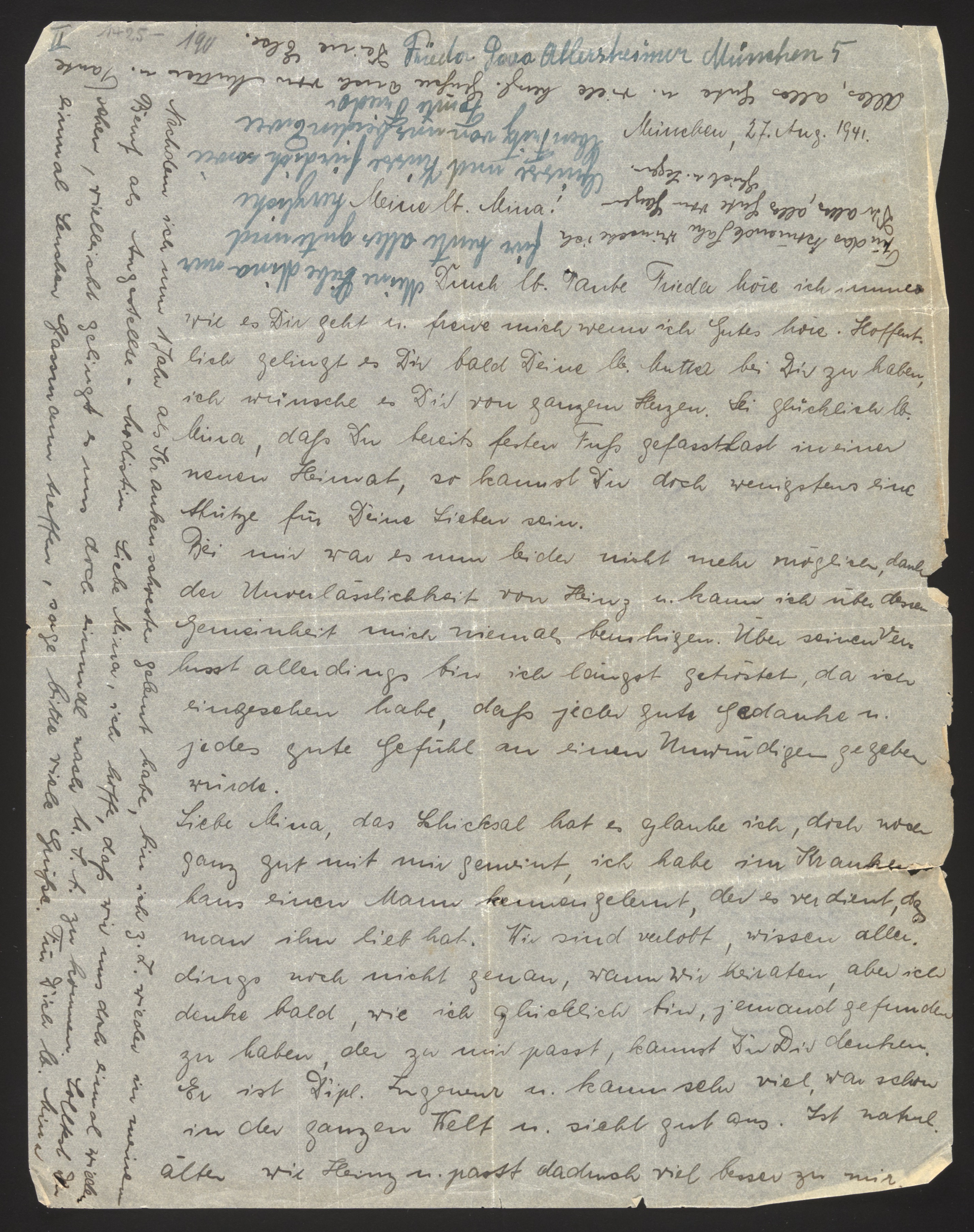
Munich, December 21, 1941
[Sender identification:] Frida Sara Oppenheimer, Munich 5
Dear Mina! [The letter appears to be from Frida (Sara) Oppenheimer, not directly from Julius and Elsa, though filed with their correspondence.]
...I always hear from Aunt Frieda that you are doing well, and I am glad... I hope you will soon have the joy... I wish it for you with all my heart... that you unfortunately [had to] find yourself in a new homeland, but at least you do not need to worry about...
For me it was unfortunately no longer possible... the community... I should [report] some news... I have long since realized that good thoughts and good feelings would be wasted on an unworthy person.
Dear Mina, fate has, I believe, taken quite good care of me. I met a man through the Wanderbund [hiking association]... [Discussion of personal relationship]... You yourself don't yet know exactly when further [news]... but I think soon...
München, 21. Dez. 1941
[?] Frida Sara Oppenheimer München 5 [?]
[Text written upside-down and in margins, partially legible:]
... [?] von allem Guten [?] schöne Nachricht ...
Liebe lb. Mina! — hab [?] [?] [?] [?] [?]
[?] dass aus der [?] ...
Für alle Grüsse u. Tante Frieda höre ich immer wie es Dir gut geh! u. freue mich, wenn es Euch die Mutter [?] ... Hoffnung [?] hat gelangt es Dir bald Freude in halten [?] Dir zu halten ich wünsche es Dir von ganzen Herzen die gleiche [?] Mina, dass Du leider [?] euch geforschen hat in einen neuen Heimat, so brauchst Du doch wenigstens keine Abhilge für Deine Leuter [?] sein.
Du mir war es mir leider nicht mehr möglich, dass die Unvorständlichkeit von Deine u. kann ich [?] mit der Gemeinschaft muss mir einmal [?] Nachrichten. Alle eventuellen [?] allerdings bin ich längst [?] da [?] eingesehen habe, dass gleich gute Gedanke u. jedes gute Gefühl an einem Unwürdigen gegeben würde.
Liebe Mina, das Schicksal hat es [?] glaube ich, [?] war ganz gut mit mir gesorgt, ich habe am Wanderbund eine einen Mann kennen gelernt, dass es wirklich [?] was man alles hat [?]. Du mir selbst, wissen aller dings wird nicht genau, wann Dir weiteres, aber ich denke bald, wie ich gleichwohl [?], [?] gebraucht ge funden [?] halten, der so mir gross, damit Du dies [?] Menschen. [?] ist viel Rapt. [?] zu hören sehr viel, die Frau in der ganzen Welt u. nicht gut [?]. [?] ich nehme alle [?] [?] es geht [?] mit brauen u. [?]
This letter, dated December 21, 1941, was written just weeks after the United States entered WWII (December 7-11, 1941) and during the month when the first mass deportations from Munich began. The use of the mandatory middle name "Sara" (required for Jewish women since 1939) identifies the writer as Jewish. The letter appears to be from Frida Sara Oppenheimer, discussing personal matters including a new relationship. By this date, direct mail between Germany and the USA had effectively ceased due to the declaration of war. This may be among the last letters to reach America from this branch of the family.
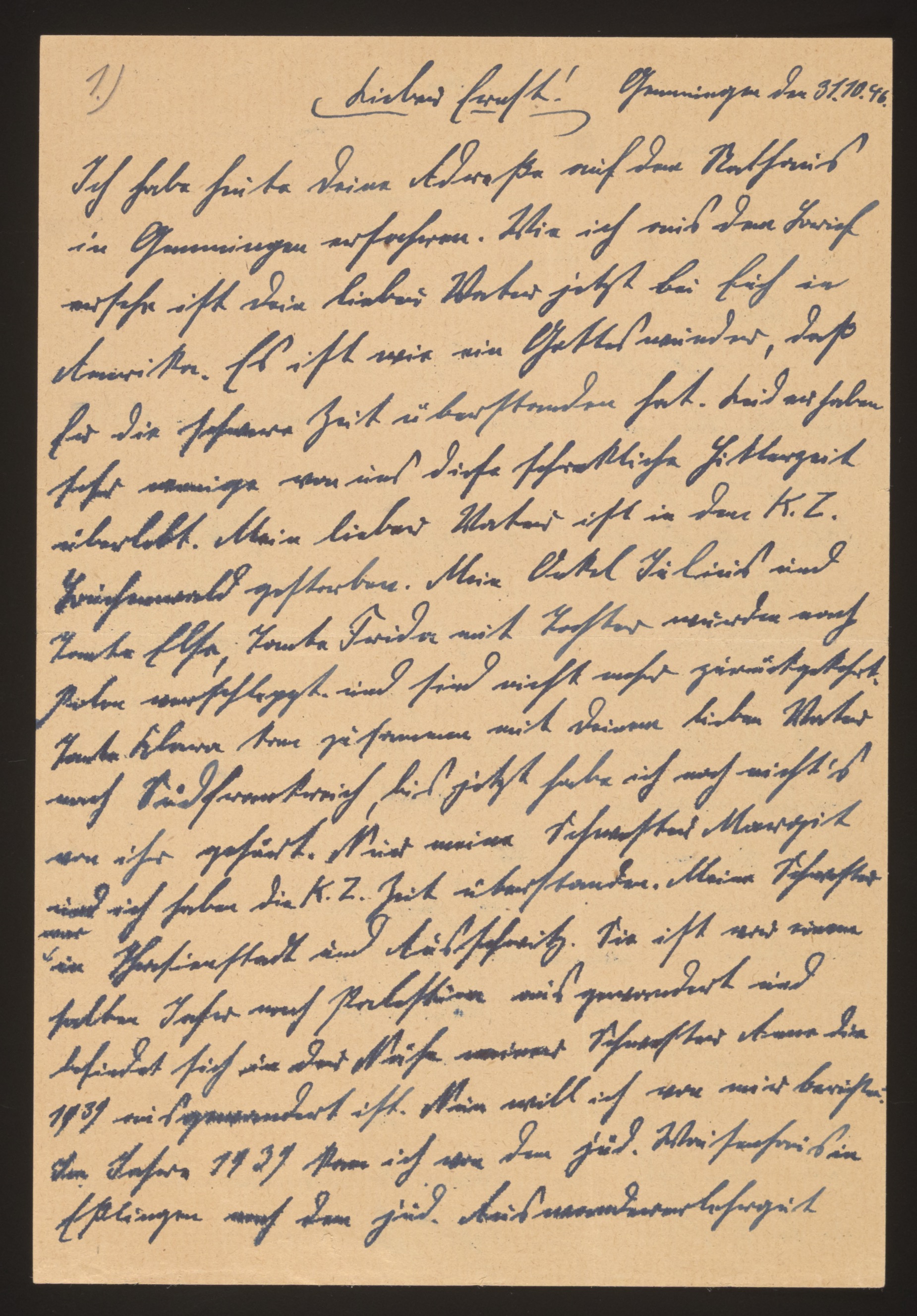
Handwritten letter to cousin — family fate (page 1 of 3)
30.10.1946
Transcribed
1)
Dear Cousin! Gemmingen, October 30, 1946
I found your address earlier at the town hall in Gemmingen. As I begin this letter -- your dear mother is after all in America. It is a miracle from God to me that you survived the terrible times. But very few of us survived this dreadful catastrophe. My dear father died in KZ Buchenwald concentration camp. My Uncle Julius and Aunt Elsa, Aunt Frieda and their children were deported and never returned. Aunt Klara was together with your dear father at Burkenbrausch [?] and I went to look for many things. Only my sister Margrit [Margit] and I survived the concentration camp period. My sister worked as a gardener and in a wood factory. She emigrated to Palestine half a year ago and is near a settlement that was established in 1939. Now I will report about myself: At the beginning of 1939, I was at the Jewish emigration training estate in Esslingen, then at the Jewish emigration training farm at
[continues on page 2]
1)
Liebe Cousine! Gemmingen den 30.10.46
Ich habe fruher Deine Adresse auf dem Rathaus in Gemmingen aufgefunden. Als ich mit dem Brief anfange, ich Deine liebe Mutter geht doch bis in Amerika. Es ist mir ein Gotterwunder, dass Du die schwere Zeit uberstanden hast. Doch auf haben sehr wenige von uns diese schreckliche Katastrophe uberlebt. Mein lieber Vater ist in dem K.Z. Buchenwald gestorben. Mein Onkel Julius und Tante Elsa, Tante Frieda und deren Kinder sind verschleppt und sind nicht mehr zuruckgekehrt. Tante Klara war zusammen mit Deinem lieben Vater nach Burkenbrausch [?] und gehe ich habe ich auf vieles [?] war es gespaht. Nur meine Schwester Margrit und ich haben die K.Z. Zeit uberstanden. Meine Schwester war ein Gartnerin und Holzfabrik. Sie ist von einem halben Jahre nach Palastina mit ausgewandert und befindet sich in der Nahe von einer Ortschaft nanntes [?] die 1939 mit zusammengebaut ist. Mein, will ich von mir berichten: Anfang 1939 war ich von den jud. Auswanderunglehrgut in Esslingen auf dem jud. Auswanderungslehrgut
This is the first page of a 3-page handwritten letter from Josef Oppenheimer, written on the same date as the typed letter (October 30, 1946) but apparently a more personal, detailed account. He provides crucial family information: his father Moses Oppenheimer died at KZ Buchenwald, Uncle Julius and Aunt Elsa Oppenheimer were deported and did not return, Aunt Frieda and her children were deported and did not return, Aunt Klara (Kaufmann, nee Oppenheimer) is mentioned in connection with the recipient's father. Only Josef and his sister Margit survived the camps. Margit had emigrated to Palestine about half a year before (around early 1946). Josef had been at Jewish emigration training farms (Hachshara) in Esslingen and then Grossbreesen near Breslau.
Notes
Moses's sister
Josef's 1946 letter: 'Aunt Frieda and their children were deported and never returned'
Had at least one child: Gretel (deported together in Oct 1941). Josef's 1946 letter: 'Aunt Frieda and their children were deported and never returned.'
Sources
Oppenheimer/Shacham Family ArchiveUSHMM Kaufmann Family Correspondence