Mina Kaufmann in New York
Before moving to Baltimore. Elsa's Jan 1941 letter: "Mina is now no longer in New York but has been in Baltimore for several weeks." 📍 New York
1941
Mina Kaufmann settles in Baltimore
Dr. Mina Kaufmann moves from New York to Baltimore (4006 Norfolk Ave.). Receives correspondence from relatives in Germany throughout the war. 📍 Baltimore
Correspondence (14 documents)
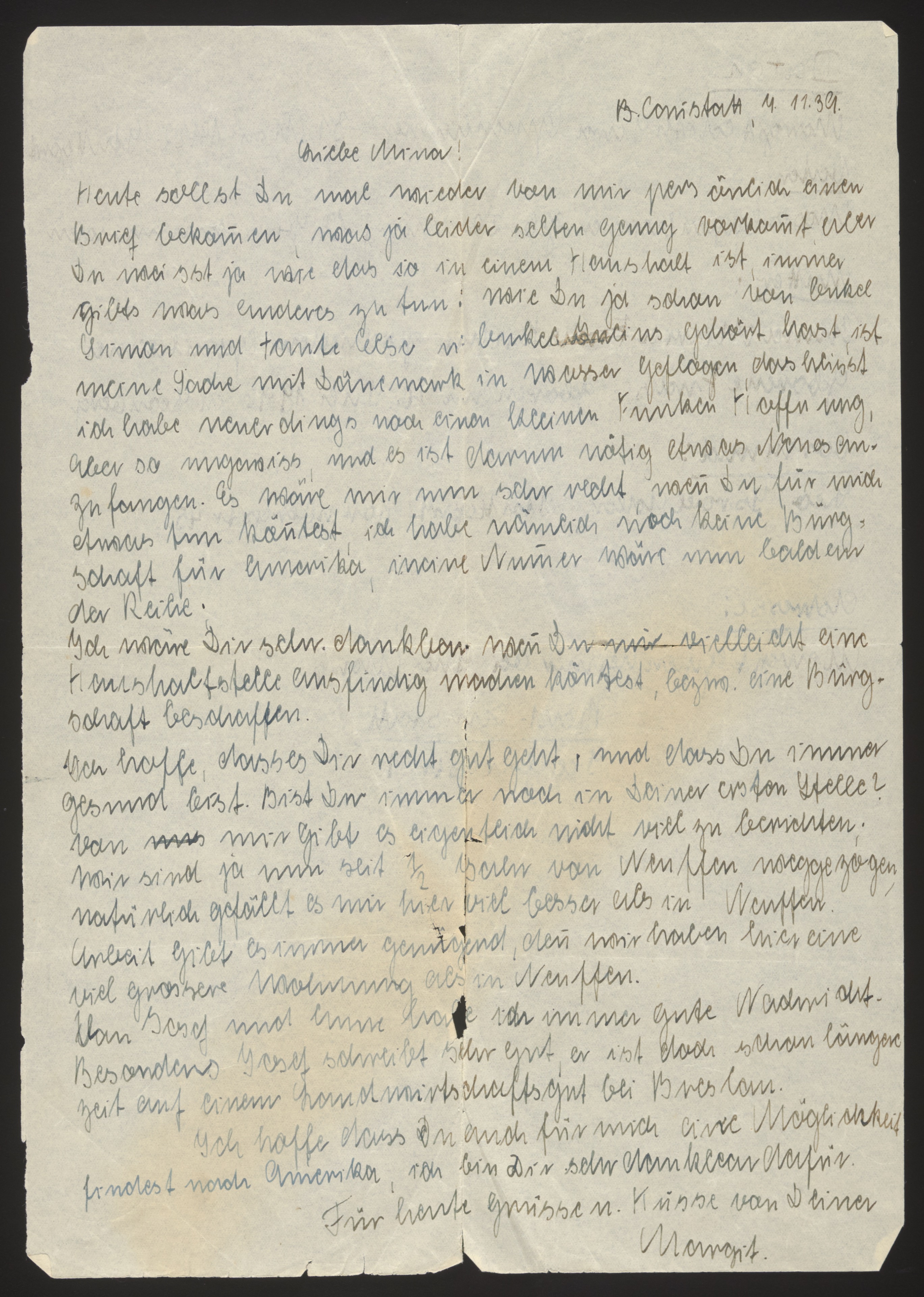
Letter seeking emigration sponsorship
04.11.1939
Transcribed
B[ad] Cannstatt, November 4, 1939.
Dear Mina!
Today you should receive another personal letter from me, which unfortunately happens rarely enough -- or as you know, in a household there is always something else to do! As you may have already heard from Uncle Simon, my plan with Denmark fell through. I recently have another small glimmer of hope, but very slim, and it is therefore necessary to start something new. It would mean a great deal to me if you could do something for me -- I do not yet have a guarantee [sponsor/affidavit] for America, and my number would soon be up [on the waiting list].
I would be very grateful if you could perhaps find me a household position, or obtain a guarantee/sponsorship.
I hope that you are doing well and that you are always in good health. Are you still at your old place? There is not much to report from us; we moved from Wuppertal half a year ago, and of course I like it much better here than in Wuppertal. There is always plenty of work, because we have a much larger apartment here than in Wuppertal.
I always hear good news from Burg and Emma. Josef writes particularly well; he has been at an agricultural estate near Breslau for quite some time now.
I hope that you will also find a way for me to get to America; I am very grateful to you for that.
For today, greetings and kisses from your
Margit.
B. Cannstatt, 4.11.39.
Liebe Mina!
Heute sollst Du mal wieder von mir personlich einen Brief bekommen, was ja leider selten genug vorkommt, oder Du weisst ja ware dass so in einem Haushalt ist immer gibts was anderes zu tun! Hast Du ja schon von Onkel Simon mal Tonite Lese in Dunkelheitein gehort hast ist meine Sache mit Danemark ins Wasser gefallen, das wusst ich habe neuerdings noch einen kleinen Funken Hoffnung, aber so magerweise, und es ist darum notig etwas Neues anzufangen. Es ware mir nun sehr wohl wenn du fur mich etwas tun konntest, ich habe namlich noch keine Burgschaft fur Amerika, meine Nummer ware nun bald an der Reihe.
Ich ware Dir sehr dankbar wenn Du mir vielleicht eine Haushaltsstelle empfindlich machen konntest, bezw. eine Burgschaft beschaffen.
Ich hoffe, dass es Dir recht gut geht, und dass Du immer gesund bist. Bist Du immer noch an Deiner alten Stelle? Von uns gibt es eigentlich nicht viel zu berichten, wir sind ja mit seit 1/2 Jahren von Wupffen verzogen, naturlich gedollt es mir hier viel besser als in Wupffen. Arbeit gibt es immer genugend, denn wir haben hier eine viel grossere Wohnung als in Wupffen.
Von Burg und Emma hore ich immer gute Nachrichten. Besonders Josef schreibt sehr gut, es ist doch schon langere Zeit auf einem Landwirtschaftsgut bei Breslau.
Ich hoffe dass Du auch fur mich eine Moglichkeit findest nach Amerika, ich bin Dir sehr dankbar dafur.
Fur heute Grusse u. Kusse von Deiner
Margit.
Margit Oppenheimer (born May 31, 1922, Stuttgart) wrote this letter at age 17, desperately seeking sponsorship to emigrate to America. Her plan to go to Denmark had fallen through. She was living in Bad Cannstatt, working as a household helper. Her brother Josef was at the Jewish agricultural training farm near Breslau. Tragically, Margit was unable to emigrate and was deported to Theresienstadt on April 2, 1943, and then to Auschwitz. She survived and emigrated to Palestine after the war, marrying Philip Bernstein.
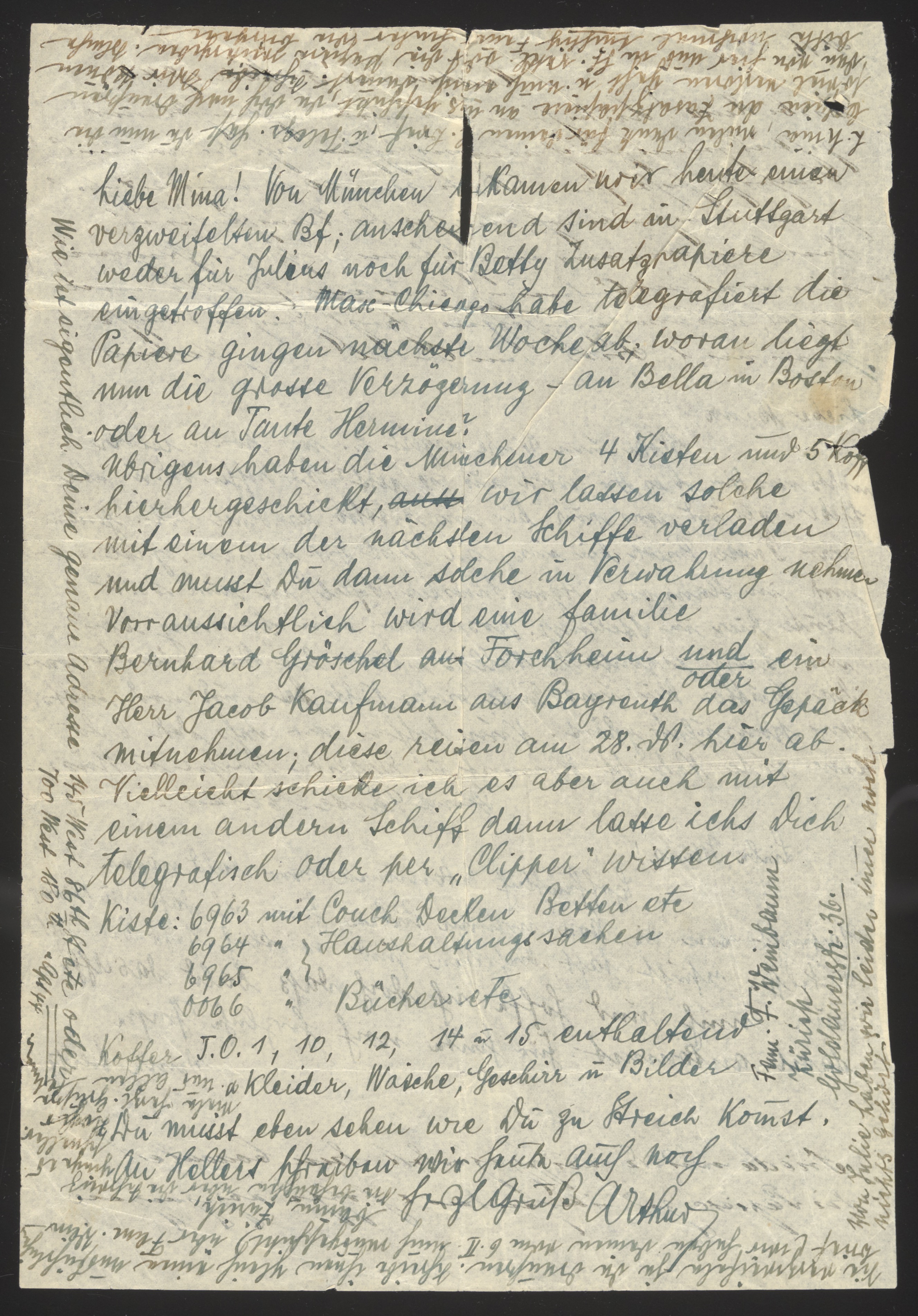
Handwritten letter discussing shipping of belongings, with inventory
1940
Transcribed
Dear Mina! From Munich we received a desperate letter today, and in Stuttgart still nothing for Betty's passport photographs has arrived. [Someone] telegraphed this week that the journey would depart next week — what is causing the great delay — Bella in Boston or Aunt Hermine?
By the way, the Munich [relatives] have sent 4 crates and 5 kg here, and we will have them loaded on one of the next ships, and you will then need to take them into storage. A family named Bernhard Göschel from Forchheim and a Mr. Jacob Kaufmann from Bayreuth will presumably bring the luggage or take it along; they depart on the 28th. Perhaps it will be sent on another ship, in which case I will let you know by telegram or by "Clipper" [airmail].
Crate: 6963 — with couch/bedding, beds, etc.
6964 — Household items
6965 — [contents not specified]
6966 — Book crate
Suitcases: I.O. 1, 10, 12, 14–18 containing clothes, linens, paintings and pictures
You must see how you can get to Erich.
[The] Kellers say how glad they are!
Warm greetings, Arthur
[Main body:]
Liebe Mina! Von München [?] bekommen wir heute einen verzweifelten [?] Brief, und in Stuttgart weiter für [?] noch für Betty Lustphotographire eingetroffen. Man [?] diese woche telegraphiert die Fahrt [?] gingen nächste Woche ab, woran liegt nun die grosse Verzögerung — an Bella in Boston oder an Tante Hermine?
Übrigens haben die Münchener 4 Kisten und 5 Kg hierhergeschickt, und wir lassen solche mit einem der nächsten Schiffe verladen und musst Du dann solche in Verwahrung nehmen. Voraussichtlich wird eine Familie Bernhard Göschel aus Forchheim und ein Herr Jacob Kaufmann aus Bayreuth das Gepäck oder mitnehmen; diese reisen am 28. [?] hier ab. Vielleicht schicken es aber auch mit einem anderen Schiff dann lasse ich Dich telegrafisch oder per "Clipper" wissen.
Kiste: 6963 mit Couch betten Betten etc.
6964 — Haushaltungssachen
6965 —
6966 — Bücherkiste
Koffer: I.O.1, 10, 12, 14–18 enthaltend Kleider, Wäsche, Gemälde u. Bilder
[?] du musst eben sehen wie Du zu Erich Komest.
[?] Kellers sprechen Wie froh sind wir!
herzl. Grüsse Arthur
This letter documents the logistics of shipping household belongings out of Germany — a critical aspect of Jewish emigration. The Oppenheimers were sending crated possessions via ship to the United States through intermediaries. The mention of passport photographs, "Clipper" airmail, and the urgency about delays reflects the desperate race to emigrate. Bernhard Göschel from Forchheim and Jacob Kaufmann from Bayreuth appear to be fellow Jewish emigrants carrying luggage on the same ship. The detailed inventory of crates and suitcases preserves a record of what the family tried to save from their household.
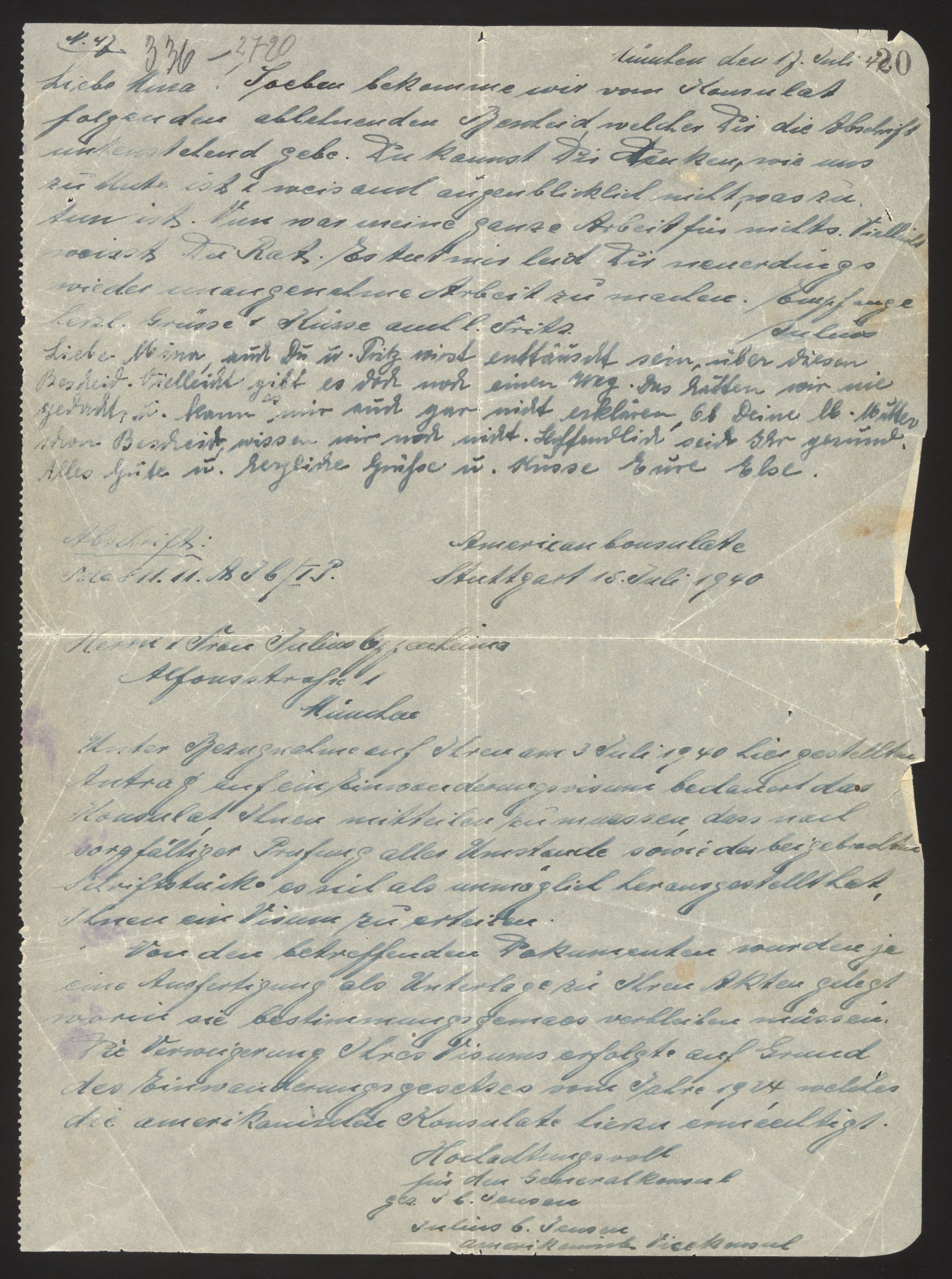
Handwritten letter with typed American Consulate document
1940
Transcribed
[Handwritten portion:]
Munich, [date] 1940
Dear Mina, we have [received?] from Hannover... [discusses everyday matters and emigration plans]...
Julius
[Second note:]
Dear Mina, I too [send you?]... the enclosed... warm greetings...
[Typed document:]
American Consulate
of the United States of America, Section 79
To Mr. and Mrs. Julius and Elsa [Oppenheimer]
Afganstrasse [?]
Munich
Stuttgart, [date] 1940
In response to your application submitted on July 3, 1940 regarding an immigration visa, the issuance [requires] your [?] all necessary papers and documents... consulate fees... to appear.
Of the submitted documents, [?] two copies... entry permit... which also [indicates?] the consulate's [requirements]...
Respectfully,
For the Consul General
[signature]
Vice Consul [?] of the United States of America at the Consulate
[Handwritten portion at top:]
München den 17. [?] [19]40
Liebe Mina, [?] haben wir vor einem [?] von Hannover [?] und [?] folgenden alltäglichen [Posten?] welcher Dir die Absicht und [?] leider [?] ... Du kennst die [Sachen?], wie [?] nur so und [?] ... wir [?] [?] jetzt [?] Absicht [?] wollte [?] ... aus [?] sind [?] ganz genau Abschriften [?] nicht [?] reist u. [?] Es das mir [?] ihre [?] wenigstens [?] nicht [?] werden ...
[?] ganze [?] klein u. würde [?] Julius
[Second handwritten note:]
Liebe Mina, auch ich [?] Dich [?] und schicke Dir [?] einem auch [?] Weg die beiliegende [?] Grüsse Dich herzlich [?]
der uns [?] nichts Besseres [?] zu erklären [?] M.b. [?]
[Typed document at bottom:]
Amerikanisches Konsulat
der V.St.M. Abt. 79
Herrn u. Frau Julius u. [?] Elsa [?]
Afganstrasse [?]
München
An der Sprechstunde auf Ihren am 3. Juli 19 40 [?] eingereichten Antrag [?] hier von Einwanderungsvisum dafür ist die Ausstellung [?] Ihres mündlichen [?] Ihres müssen das [?] erforderliches Papiere alle Antworten [?] der [?] Möglichkeit u. Ihre als etwas [?] der Konsulatsgebühren [?] hiermit mir [?] zu erscheinen.
Von das bekanngegebnen Dokumenten wurden [?] zwei Kopie [?] eine Bestellung oder [?] von [?] und [?] Abstimmungsterminen mitteilen [?] wir [?] wir die Einreiseerlaubnis [?] gab Seite 19 [?] welches auch daraus [?] Konsulats der Reisen auswärtige lässt.
Hochachtungsvoll
Für den Generalkonsul
[?] d. B. Gemein [?]
Vizekonsul B. [?] der Vereinigten Staaten von Amerika bei dem Konsulat
This is an exceptionally important document. It contains an official response from the American Consulate in Stuttgart regarding Julius and Elsa Oppenheimer's application for an immigration visa to the United States, filed on July 3, 1940. The U.S. Consulate in Stuttgart handled visa applications for the southern German region. By 1940, the visa process had become extremely difficult, with long waiting lists, extensive documentation requirements, and the need for affidavits of support from American relatives. This document represents part of the paper trail of the Oppenheimers' ultimately unsuccessful attempt to emigrate. Julius and Elsa Oppenheimer were later deported and murdered in the Holocaust.
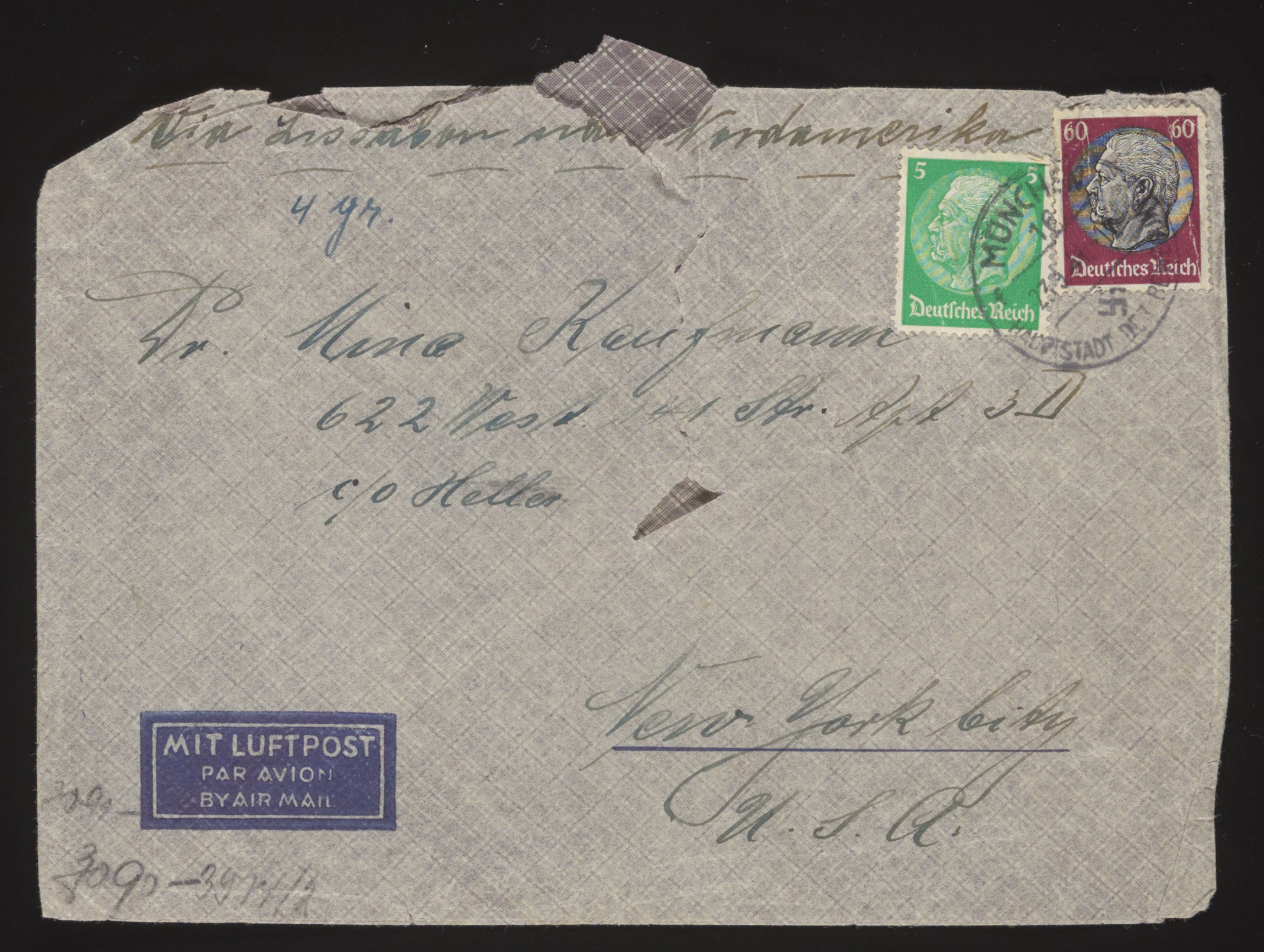
Envelope front — airmail letter
1941
Transcribed
Airmail envelope front. Addressed to:
Dr. Mina Kaufmann
622 West [?] 43 St. [crossed out]
c/o Heller [?]
4006 Norfolk Ave.
Baltimore, Maryland
U.S.A. [crossed out and rewritten as "New York" then corrected back]
Stamps: Two Deutsches Reich postage stamps — a green Hindenburg stamp and a dark red/brown Hindenburg stamp. "MIT LUFTPOST / PAR AVION / BY AIR MAIL" label at lower left. The address appears to have been corrected multiple times, with "New York" crossed out and redirected to Baltimore.
None
None
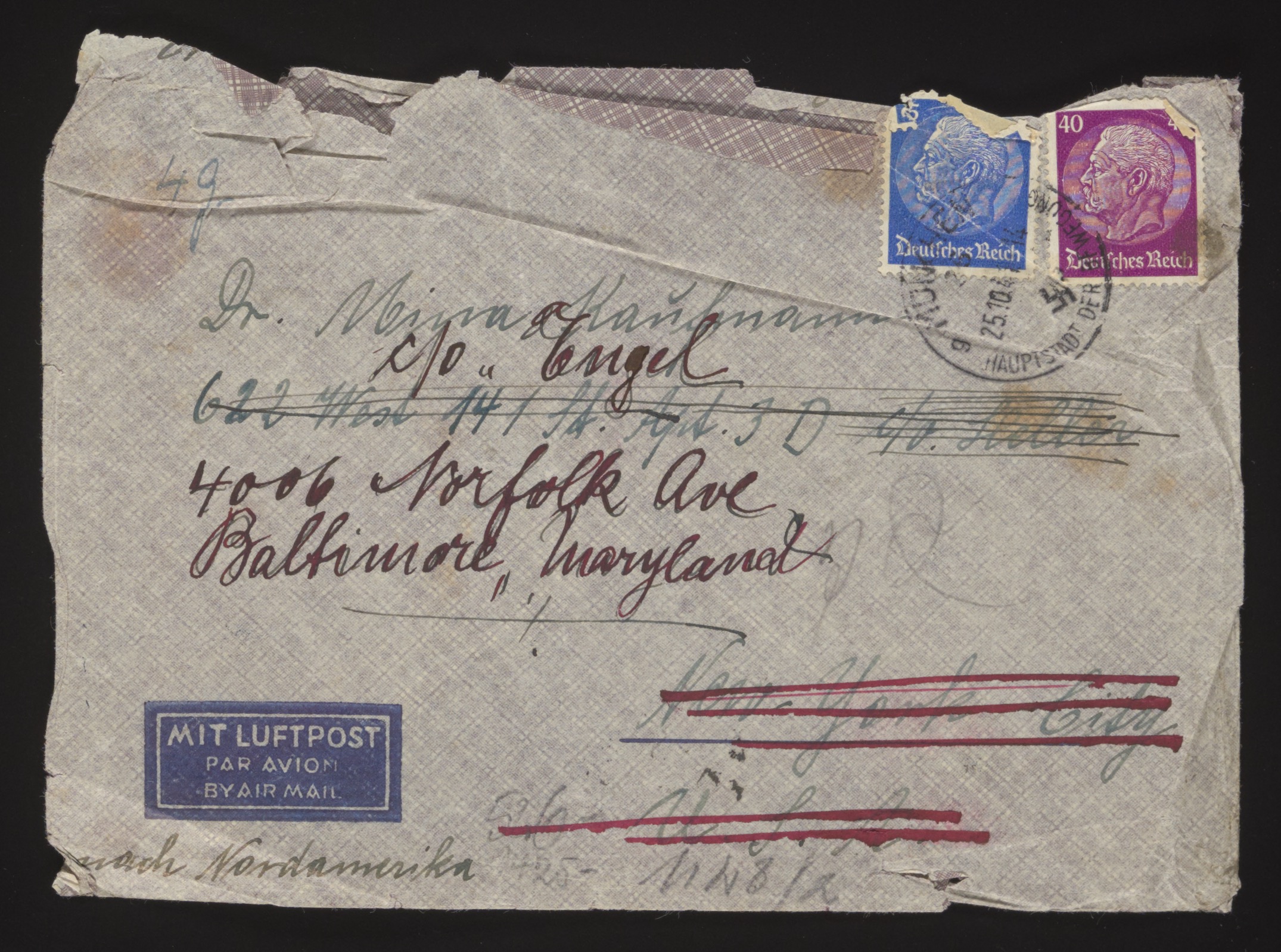
Envelope front — airmail letter
1941
Transcribed
Airmail envelope front. Addressed to:
Dr. Mina Kaufmann
c/o Engel
664 [?] Norfolk [?] Ave [crossed out/corrected]
4006 Norfolk Ave.
Baltimore, Maryland
Stamps: Two Deutsches Reich postage stamps (Hindenburg portraits — purple/violet and brown). "MIT LUFTPOST / PAR AVION / BY AIR MAIL" label at lower left. Address has been corrected, with some portions crossed out with diagonal red lines.
None
None
Typed letter (page 2), continuation from fragment in 0004
1941
Transcribed
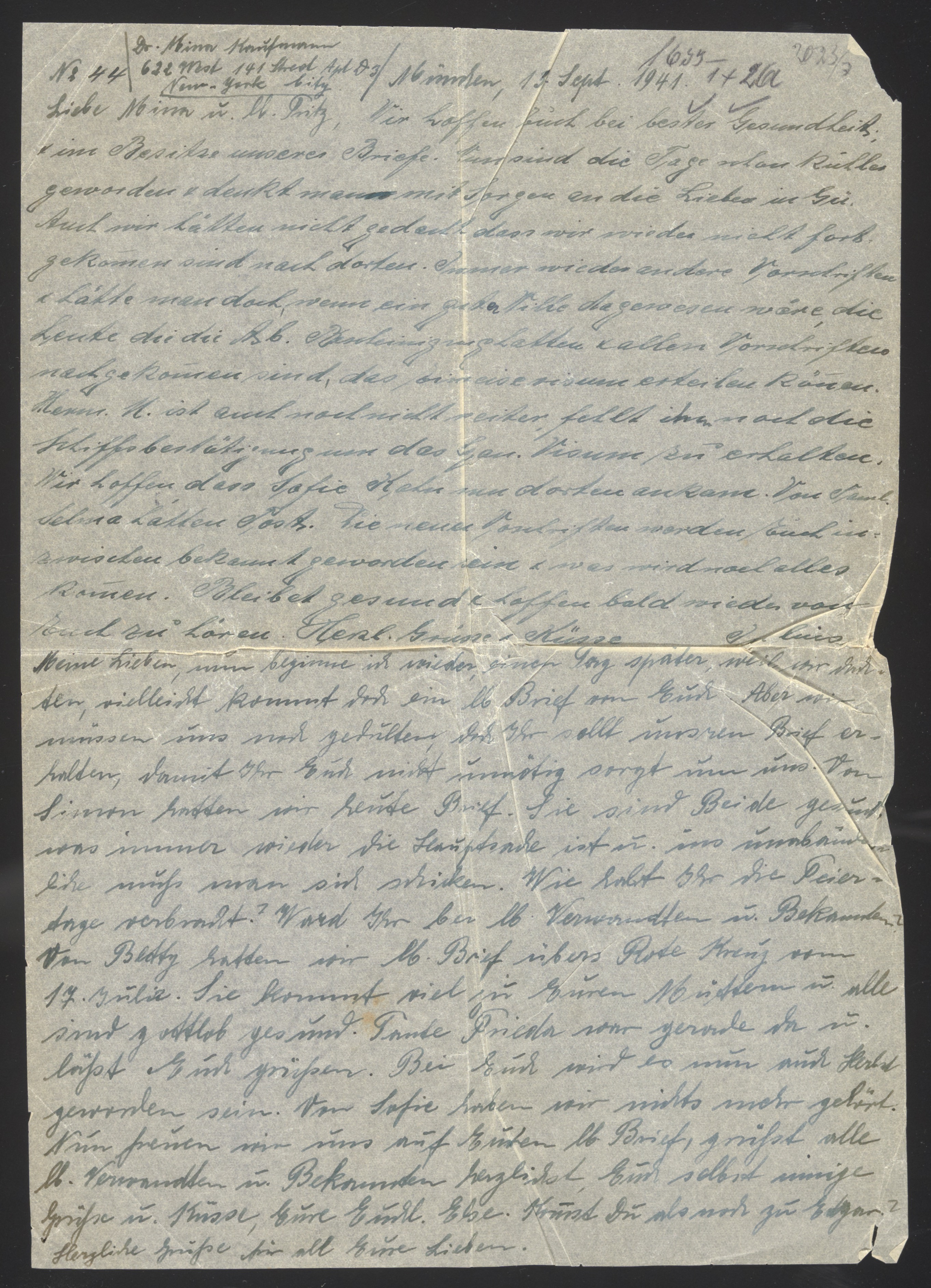
2
family (from Ralf, Stadthagen). Dr. B. was formerly a lecturer at the University of Berlin and has now been in the same position at the University of Princeton for about 3 years. His wife is a very good acquaintance of mine; the father of this gentleman was also very well known to me. The in-laws have for their part already written to their son-in-law. He will gladly stand by you not only with advice but also with action. So please take the time to get in touch with him immediately. I am delighted [to hear] and for all that R. has stood by me in the most necessary way, I ask you to convey my best thanks. What are the other relatives in New York doing? And how are Dr. Max and his brothers? From his father, and also from Ida, I have heard nothing despite the greatest effort. Dr. Rosenthal has been in San Francisco since June, where he is currently working as an instructor in military service training. He believes he will eventually find a position there in his field. His address is: Dr. Rosenthal c/o Dr. Hans Aberg, 3147 Mission Street, San Francisco, California, née mother of Mrs. Dr. Seebach. [She] passed away last year and was buried on the farm. If you would send condolences there, that would be very appropriate. From Anna I have heard nothing since last month. Josef is still in Gross-Breesen. Beyond that, I have no further news to report. I would like to close now with the wish that you may stay healthy and that you can have your mother come to stay with you. Stay very well, greet all acquaintances, and receive the warmest greetings and kisses from your uncle
Simon
2
Familie (aus Ralf, Stadthagen). Dr. B. war früher Dozent an der Universität Berlin und ist jetzt seit circa 3 Jahren in gleicher Position an der Universität in Princeton. Dir Frau ist eine sehr gute Bekannte von mir, auch der Vater dieses Herrn war mir sehr bekannt. Die Schwiegereltern haben ihrerseits bereits an Ihren Schwiegersohn geschrieben. Derselbe wird Dir gerne nicht nur mit Rat, sondern auch mit Tat zur Seite stehen. Also Dir also bitte so viel Zeit [nehmen] Dich sofort mit demselben in Verbindung. Ich freue mich von [Herzen] und was mir zuvor R. in allernotiger Weise beigestanden hat und bitte ich Dir hiermit meinen besten Dank zu bestellen. Was machen die übrigen Angehörigen in New York? Und wie geht es Dr. Max und seinen Brüdern? Von seinem Vater, ebenso auch von Ida habe ich trotz grösster Mühe nicht gehört. Dr. Rosenthal ist seit Juni schon in San Franzisko, wo er sich augenblicklich als Instrukteur beim Militärdienst zur Ausbildung beschäftigt. Er glaubt dort irgend eine Anstellung in seinem Fach später zu erhalten. Die Adresse von ihm ist: Dr. Rosenthal c/o Dr. Hans Aberg, 3147 Missionstreet, San Francisco / Californien, geb. Mutter von Frau Dr. Seebach. [Sie] ist bereits voriges Jahr verschieden und auf der Farm beigesetzt. Wenn Du dahin kondolieren würdest, wäre dieses sehr angebracht. Von Anna mehr ich seit letzten Monats nichts gehört. Josef ist noch in Gross Breesen. Vielmehr weiss ich auch nicht zu unterrichten. Ich möchte jetzt mit dem Wunsche schliessen, dass Du gesund bleiben mögest und lass Deine Mutter bei Dir sehen kannst. Bleibe recht gesund, grüsse alle Bekannten und empfange die herzlichsten Grüsse und Küsse von Deinem Onkel
Simon
This continuation reveals Simon's network of contacts and the scattered state of the family by late 1941. The reference to Dr. Breuer at Princeton University reflects the network of German-Jewish intellectuals who had emigrated to American academia. Dr. Rosenthal working as a military instructor in San Francisco shows Jewish refugees contributing to U.S. military preparedness before America's entry into WWII (December 1941). The mention of "Josef is still in Gross-Breesen" refers to the Gross-Breesen agricultural training farm near Breslau (now Wrocław, Poland), a Zionist-inspired agricultural training center that prepared young Jews for emigration through farming skills. Communication was limited to Red Cross messages, and Simon expresses hope that Mina can bring her mother to the United States. Simon's closing wish — that his niece stay healthy and be reunited with her mother — carries poignant weight given his own impending fate.
Handwritten letter
15.09.1941
Transcribed
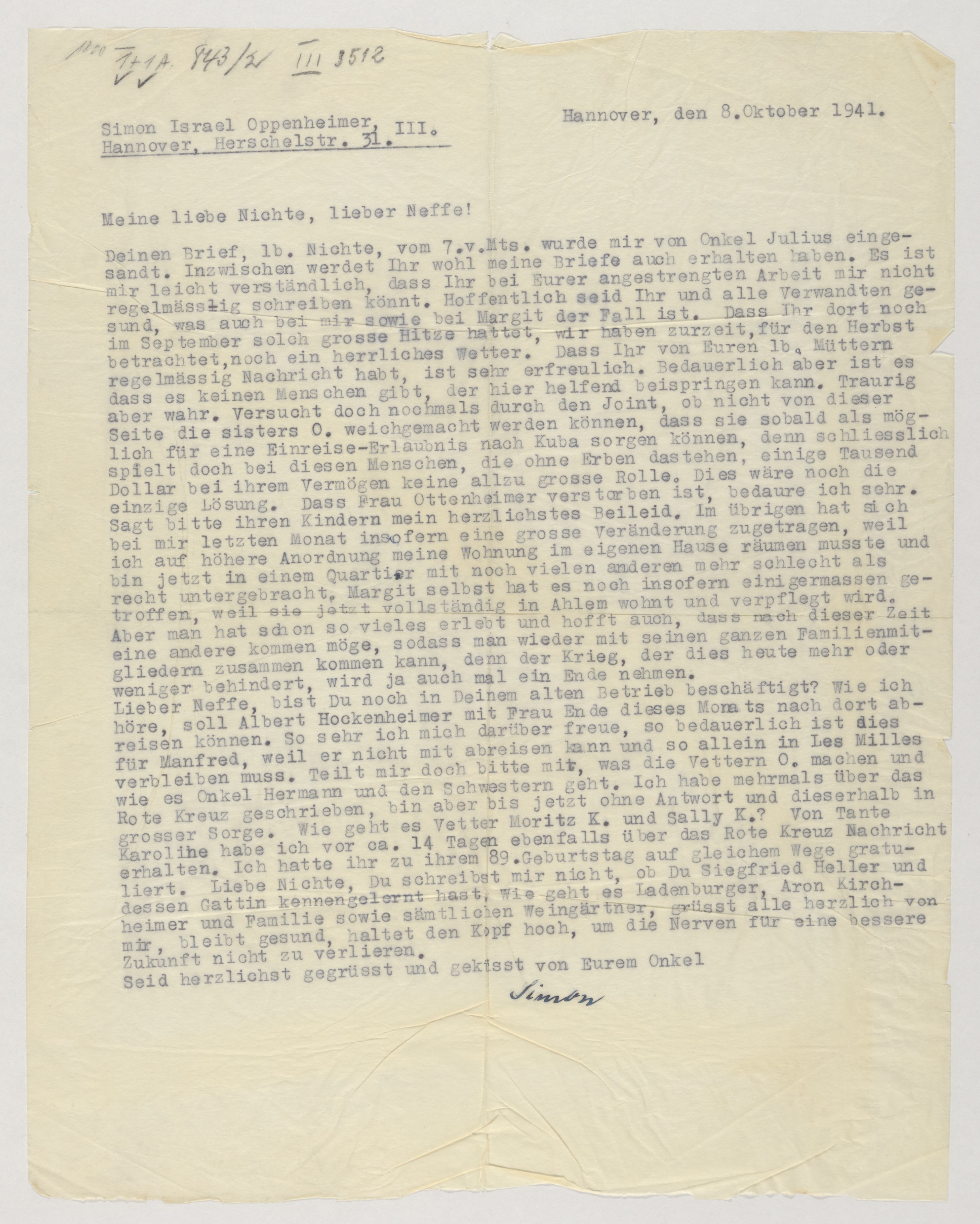
Munich, September 15, 1941
Dear Mina and dear [family],
[The letter discusses receiving correspondence on Saturdays, references to ongoing matters with various relatives, mentions Bella, emigration efforts, Holland, and Karl. The writer updates Mina on family news and the increasingly difficult situation.]
Dr. Mina Kaufmann
[?] Abt. [?] Brief; [?] München 15 Sept. 1941 [?] [?]
Liebe Mina u. lb. [?]
Es köpfen [?] uns liebe Samstäglich kam also [?] [?] Briefe manches [?] allerdings [?] manns noch fragen es [?] die lieber es [?] hat nur [?] nicht Alles gehennen [?] und noch Adern [?] mir wieder andere Verwandter [?] u. als stellt [?] auch und diese grosse Bitte alle [?] zusammen welches bei der [?] des 1.V. [?] [Auswanderung?] [?] das Gebiet an Bella in [?] die im [?] wurde [?] und Alberts [?] seid kommen also [?] dazu [?] Gescheiten [?] ...
[Multiple paragraphs continuing in Kurrent — mentions Betty, Holland, emigration, Karl]
Written just four days before the mandatory wearing of the Yellow Star was enforced (September 19, 1941), this letter reflects the last weeks before the most visible marker of persecution was imposed on German Jews. The references to emigration at this late date show that some still held out hope, even as exit routes had largely closed.
Typed letter (page 1 of 2) from Simon Israel Oppenheimer III to his niece Min...
08.10.1941
Transcribed
Simon Israel Oppenheimer III.
Hannover, Herschelstrasse 31.
Hannover, October 8, 1941.
My dear niece, dear nephew!
Your letter, dear niece, of the 7th of last month was forwarded to me by Uncle Julius. In the meantime, you will have received my letters as well. I can easily understand that with all your work you cannot always write punctually. Hopefully you and all the relatives are well, which is also mostly the case with me. For the [autumn] we do not have such great heat as you do; we still have wonderful weather for this time of the autumn. That you receive regular news from nephew D. Katten is very pleasing; in Hannover, however, it is unfortunately the case that one can [barely get field post through]. Sad, but true. Do try once more through the Joint [Distribution Committee] whether it might be possible to learn the address of O., so that as soon as possible an entry [permit] toward Cuba could be arranged for him, because after all, with these people, for whom the Dollar plays such a big role, it would mean the least [difficulty]. I am very sorry to hear that Mrs. Ottenheimer has passed away. Please give my heartfelt condolences to her children. I have in the past months still had some things to move, and under current orders I had to vacate my apartment into [another] house and am now in quarters that are something quite different from what one is accustomed to. Margit herself still has it somewhat bearable insofar as she now lives entirely in the old [place] and manages. But one has already [adjusted] to this, and one will surely see each other again, just as one will come together again with one's whole family, because the war — you must also see this — will come to an end someday.
Dear nephew, are you still employed at your old business? As I [learned] from your wedding day... [several lines difficult to decipher due to typewriter quality]... Please go to Mrs. Gundersheimer, with her I have left a box of [Glanzbilder/collectible cards] for you, with great care. How are Aunt Sophie K. and Sally K.? From Aunt Henny I also received news about 14 days ago through the Red Cross. I was very glad to receive greetings for the holidays as usual... [additional personal greetings, partially illegible]... So once again, warmest greetings from your uncle.
Be most warmly greeted and kissed by your uncle
Simon
Simon Israel Oppenheimer III.
Hannover, Herschelstr. 31.
Hannover, den 8. Oktober 1941.
Meine liebe Nichte, lieber Neffe!
Deinen Brief, lb. Nichte, vom 7. v. Mts. wurde mir von Onkel Julius eingesandt. Inzwischen werdet Ihr wohl meine Briefe auch erhalten haben, mir leicht verständlich, dass Ihr bei Eurer Vielarbeit erst nicht immer pünktlich schreiben könnt. Hoffentlich seid Ihr und alle Verwandten gesund, was auch bei mir zum grössten Teil der Fall ist. Für den [Herbst] zu haben wir nicht solch grosse Hitze wie bei Euch; wir haben zurzeit für den Herbst betrachtet noch ein herrliches Wetter. Dass Ihr vom Neffen D. Katten regelmässig Nachricht habt, ist sehr erfreulich, in Hannover aber ist es leider so, dass man hier Feldpost beigrimmmen kann. Traurig, aber wahr. Versucht doch nochmals durch den Joint, ob nicht von dort die Adresse O. er etwas erfahren werden könnte, dass er sobald als möglich, um ihn eine Einreise-[Erlaubnis] Richtung nach Kuba sorgen können, denn schliesslich spielt doch bei diesem Menschen, die das Wort [?] Dollar bei denen keine solche, alldem grosse Rolle. Dies wäre noch die wenigsten [?]. Dass Frau Ottenheimer verstorben ist, bedauere ich sehr. Sagt bitte Ihren Kindern mein herzliches Beileid. Ich habe bis jetzt in den letzten Monats immer noch etwas Verkleidung nachtragen, und bei jetziger Anordnung meine Wohnung in eigenes Haus räumen müssen und bin jetzt in einem Quartier das doch etwas anderes ist [als] man gewöhnt ist. Margit selbst hat es noch insofern einigermassen [erträglich], weil sie jetzt Vollständig in Altem wohnt und sorgen [?]. Aber man hat sich da schon zu [?], oder man [?] und dort und man sieht sicher wieder, ebenso man wieder mit seinen ganzen Familiengliedern zusammen kommen kann, denn der Krieg, das müsst Ihr ja auch wohl einsehen, wird ja auch mal ein Ende nehmen.
Lieber Neffe, bist Du noch in Deinem alten Betrieb beschäftigt? Wie ich damals von Eurem Hochzeitstag mir Eurer Freund[?]. Be danach auch nach langem der Partner frei ist, würde es mich sehr freuen. Du wirst ich das Er darber freut kann und so allein in diesem Milieu verbleiben [?]. Wenn auch die bitte bitte Dir und Deine Mutter in Eurem Haus. Leb wohl jetzt mein Lieber u. lass Mich bitte baldmöglichst über Dich hören. Geh zu Frau Gundersheimer, bei dieser habe ich Dir eine Schachtel von Glanzbilder in Grosser Sorge. Wie geht es Tante Sophie K. und Sally K.? Von Tante Henny Mues ich Dir von ca. 14 Tagen ebenfalls über das Rote Kreuz Nachricht erhalten. Ich habe für zu Grosser Freude auf die Feiertage und wie übliche [?] Grüsse. Auch Nichte, ich schreibe Dir nicht, ob Siegfried Heller und dessen Gattin [?] reguliert habt wie geht es Leutrungen. Anna Kloten von Heimer und Familie Erwin [?] es ihnen. Also nochmals alle herzlichen Grüsse von Euren Onkel.
Seid herzlichst gegrüsst und geküsst von Eurem Onkel
Simon
This letter, dated October 8, 1941, was written just weeks before the first mass deportation of Jews from Hannover (on December 15, 1941, to Riga). Simon's mention of being forced to vacate his apartment reflects the Nazi policy of "Zusammenlegung" — the compulsory relocation of Jews into designated "Judenhäuser" (Jewish houses), which concentrated Jewish residents into overcrowded shared quarters as a prelude to deportation. His use of the mandatory middle name "Israel" (required since 1939) is visible in the letterhead. Communication was increasingly restricted — Simon notes receiving news only through the Red Cross. His attempts to arrange emigration to Cuba through the Joint Distribution Committee reflect the desperate search for any escape route. The letter reveals a man trying to maintain family connections and a sense of normalcy while living under increasingly dire conditions. Simon Israel Oppenheimer III was deported from Hannover and murdered in the Holocaust.
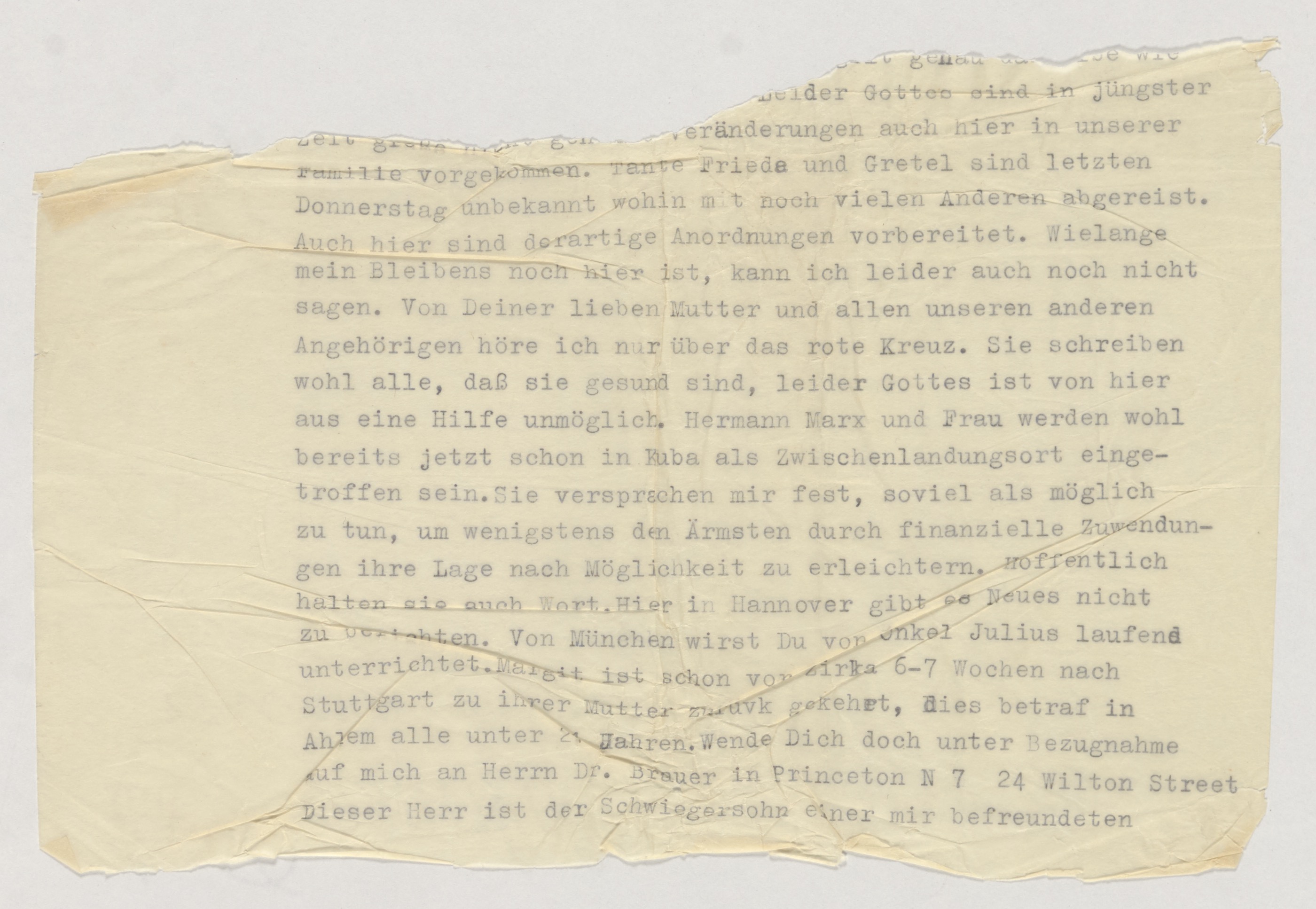
Typed letter fragment
08.10.1941
Transcribed
[Top of page damaged/torn, text begins mid-sentence]
...unfortunately, God willing, in recent [times] ... changes have also occurred here in our family. Aunt Frieda and Gretel departed last Thursday to an unknown destination, along with many others. Such arrangements are also being prepared here. How long I will remain here, I unfortunately cannot yet say. From your dear mother and all our other relatives, I hear only through the Red Cross. They all write that they are well; unfortunately, from here any help is impossible. Hermann Marx and his wife will probably have already arrived in Cuba as an intermediate stop by now. They firmly promised me to do as much as possible to at least ease the situation of the poorest through financial contributions. Hopefully they will keep their word. Here in Hannover there is nothing new to report. From Munich you will be kept up to date by Uncle Julius. Margit already returned about 6–7 weeks ago to Stuttgart to her mother; all of this was under the old [arrangements]. Please contact, with reference to me, Dr. Breuer in Princeton, N.J., 24 Wilton Street. This gentleman is the son-in-law of a family I am friends with —
[Top of page damaged/torn, text begins mid-sentence]
...leider Gottes wird in jüngster [Zeit] ... Veränderungen auch hier in unserer Familie vorgekommen. Tante Frieda und Gretel sind letzten Donnerstag unbekannt wohin mit noch vielen anderen abgereist. Auch hier sind derartige Anordnungen vorbereitet. Solange mein Bleiben noch hier ist, kann ich leider auch noch nicht sagen. Von Deiner lieben Mutter und allen unseren anderen Angehörigen höre ich nur über das Rote Kreuz. Sie schreiben wohl alle, dass sie gesund sind, leider Gottes ist von hier aus eine Hilfe unmöglich. Hermann Marx und Frau werden wohl bereits jetzt schon in Kuba als Zwischenlandungsort eingetroffen sein. Sie versprachen mir fest, soviel als möglich zu tun, um wenigstens den Ärmsten durch finanzielle Zuwendungen ihre Lage nach Möglichkeit zu erleichtern. Hoffentlich halten sie auch Wort. Hier in Hannover gibt es Neues nicht zu berichten. Von München wirst Du von Onkel Julius laufend unterrichtet. Margit ist schon von circa 6–7 Wochen nach Stuttgart zu ihrer Mutter zurückgefahrt, dies betraf in Altem alles unter D. Nahren. Wende Dich doch unter Bezugnahme auf mich an Herrn Dr. Breuer in Princeton N.J. 24 Wilton Street. Dieser Herr ist der Schwiegersohn einer mir befreundeten
This fragment is of exceptional historical significance. The passage about "Aunt Frieda and Gretel" who "departed last Thursday to an unknown destination, along with many others" is a direct reference to deportation. The phrase "unbekannt wohin" (to an unknown destination) was the common way Jews in Germany described deportations — they did not know where the transports were headed. Simon's ominous statement "Such arrangements are also being prepared here" and "How long I will remain here, I unfortunately cannot yet say" reveals his awareness that deportation from Hannover was imminent. The mention of communication only through the Red Cross, the impossibility of help from Germany, and the reference to Cuba as an "intermediate stop" (Zwischenlandungsort) all reflect the increasingly desperate and isolated situation of Jews remaining in Germany in late 1941. The systematic deportations from Hannover began on December 15, 1941, when approximately 1,001 Jews were deported to Riga.
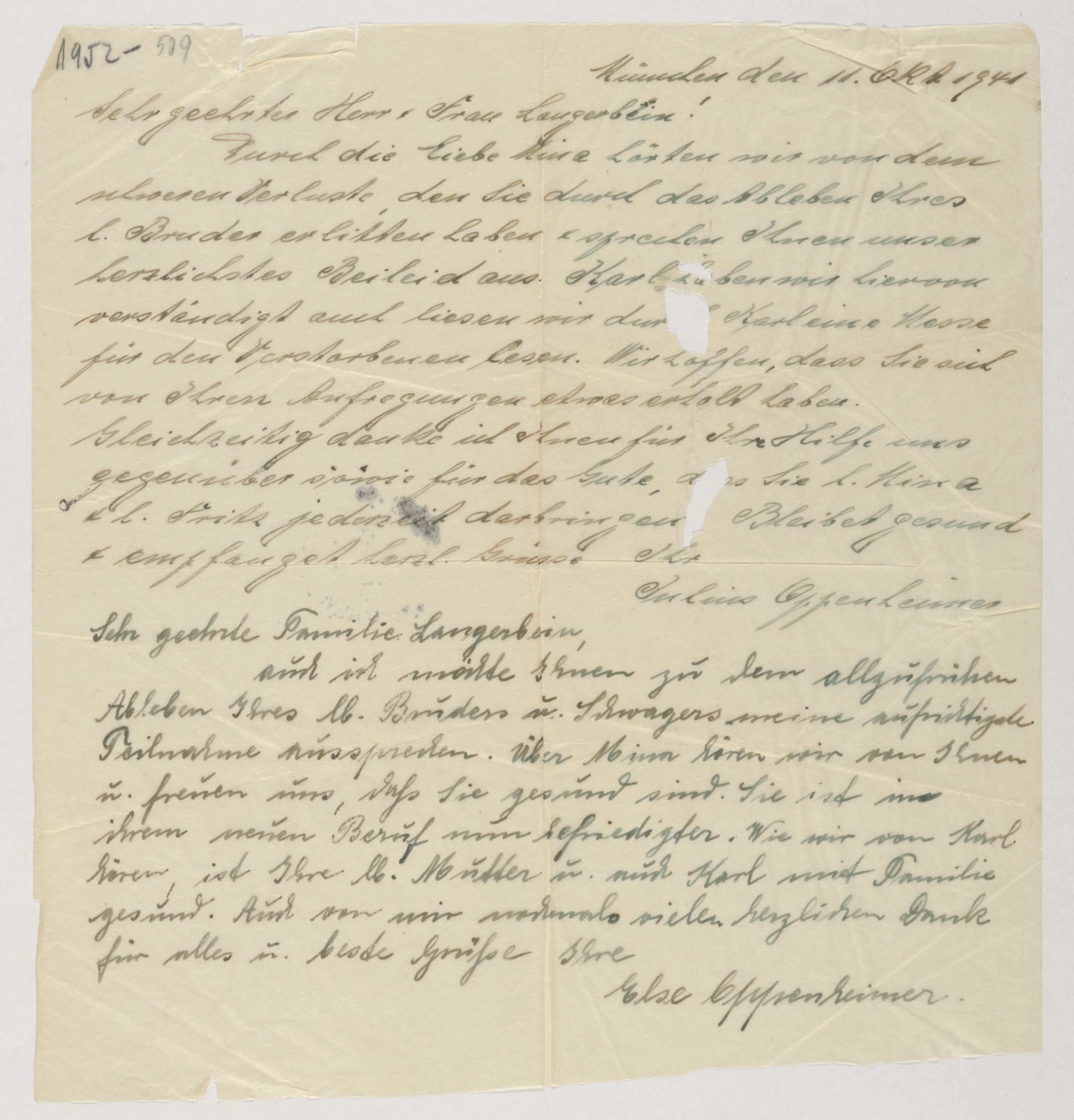
Handwritten letter — two separate notes: a condolence letter and a personal note
11.10.1941
Transcribed
[First section:]
Munich, October 11, 1941
Dear Mr. and Mrs. Langstein!
Through dear Mina, we learned of the untimely passing of your dear brother and beloved [relative], and we express our most heartfelt condolences. At the same time, we have been informed and have arranged through Mr. Herre to have [prayers] read for the deceased. We hope that you have somewhat recovered from your grief.
At the same time, I thank you for your help toward me... for the good that you and dear Mina [have done]... a package was sent and received...
Julius Oppenheimer
[Second section:]
Dear Langstein family,
I too would like to express my sincere condolences on the untimely passing of your dear brother and brother-in-law. Through Mina here we hear from you and are glad that you are healthy. She is very content in her new profession. As we hear from Karl here, your dear mother and Karl and family are also healthy. And from me once again many heartfelt thanks for everything.
With warm greetings, yours,
Elsa Oppenheimer
[First section:]
München den 11. Okt. 1941
Sehr geehrter Herr u. Frau Langstein!
Durch die liebe Mina liessen mir von dem allzufrühen Ableben Ihres lb. Bruders u. lieben Landes u. sprechen Ihnen unsere herzlichste Beileid aus. Gleichzeitig sind wir hiervor verständigt und lassen wir durch Herrn Herre für den Verstorbenen lesen. Wir hoffen, dass Sie viel von Ihrem Aufzügernen etwas erholt haben.
Gleichzeitig danke ich Ihnen für [?] Ihre Hilfe mich gegenüber [?] für das Gute, das Sie lb. Mina u. [?] Seide [?] doch ist das bringt [?] Paket [?] gesand u. empfangen [?] Grüsst [?]
Julius Oppenheimer
[Second section:]
Sehr geehrte Familie Langstein,
auch ich möchte Ihnen zu dem allzufrühen Ableben Ihres lb. Bruders u. Schwagers meine aufrichtige Beilnahme aussprechen. Über Mina hier können wir von Ihnen u. freuen uns, dass Sie gesund sind. Sie ist in ihrem neuen Beruf [?] sehr zufrieden. Wie mir von Karl hier, ist Ihre lb. Mutter u. auch Karl mit Familie gesund. Und von mir nochmals vielen herzlichen Dank für alles Eins. Liebe Grüsse Ihre
Elsa Oppenheimer
This condolence letter from Julius and Elsa Oppenheimer to the Langstein family, written just weeks before the mass deportations began, reveals the family's continued adherence to social customs and human kindness even under extreme persecution. The mention of Mina's "new profession" (neuer Beruf) may indicate she had found work in America. Karl appears to be a family member still in the Munich area. Julius and Elsa write from Ainmillerstrasse 19/II in Munich, where they were confined.
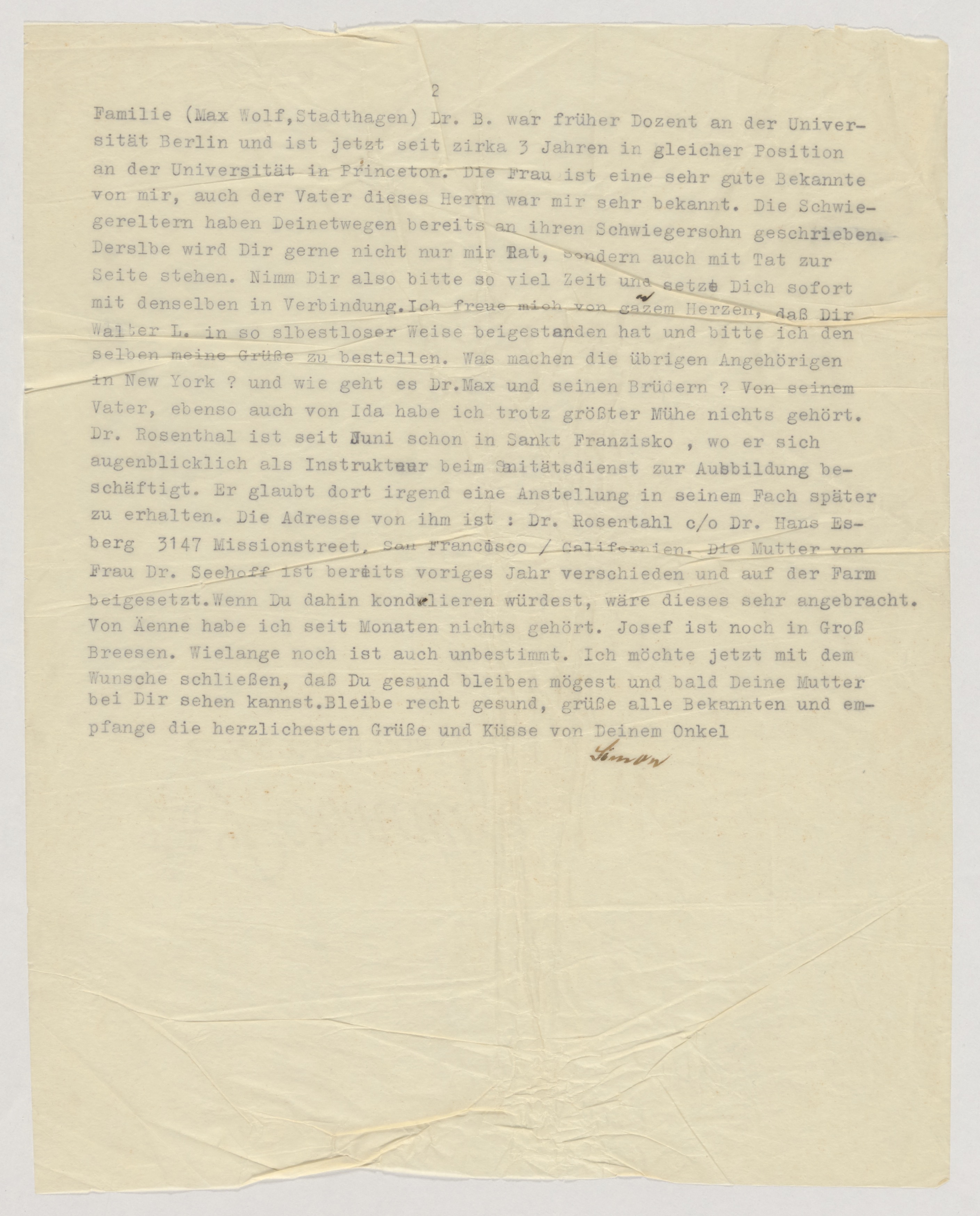
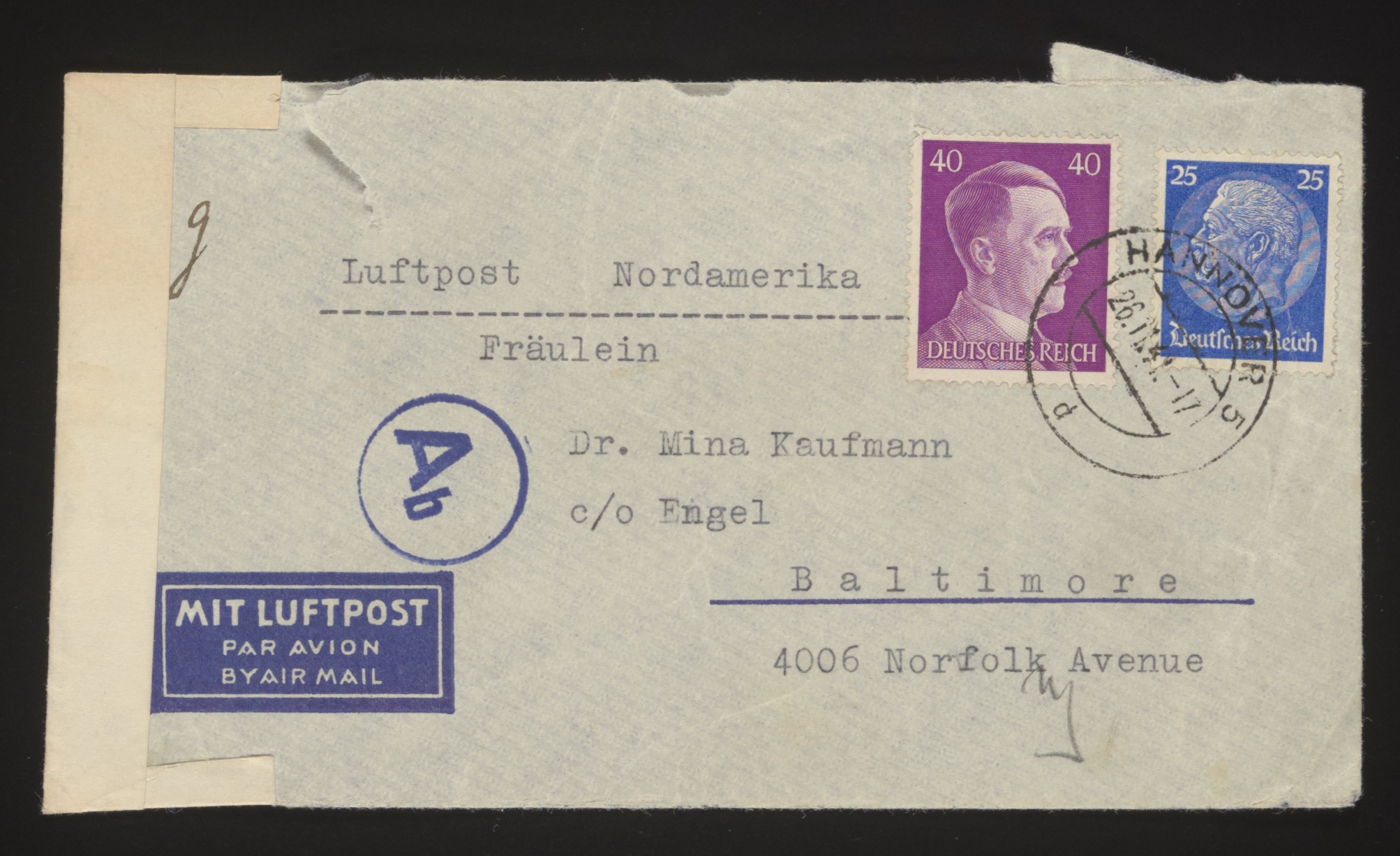
Envelope front — airmail letter
10.1941
Transcribed
Airmail envelope front. Addressed to:
Luftpost Nordamerika [Airmail North America]
Fräulein
Dr. Mina Kaufmann
c/o Engel
Baltimore
4006 Norfolk Avenue
Stamps: Two Deutsches Reich postage stamps — a 40 Pfennig stamp (Adolf Hitler portrait) and a 25 Pfennig stamp (Paul von Hindenburg portrait). Blue "MIT LUFTPOST / PAR AVION / BY AIR MAIL" label affixed at lower left. Circular censor mark "Ab" visible. Postmark: Hannover.
None
This envelope carried a letter from Simon Israel Oppenheimer III in Hannover to his niece Dr. Mina Kaufmann in Baltimore. The use of the mandatory middle name "Israel" (required for Jewish men by the Nazi decree of August 17, 1938) and the Deutsches Reich stamps with Hitler's portrait reflect the conditions under which German Jews corresponded in 1941. The censorship marks indicate wartime mail inspection.
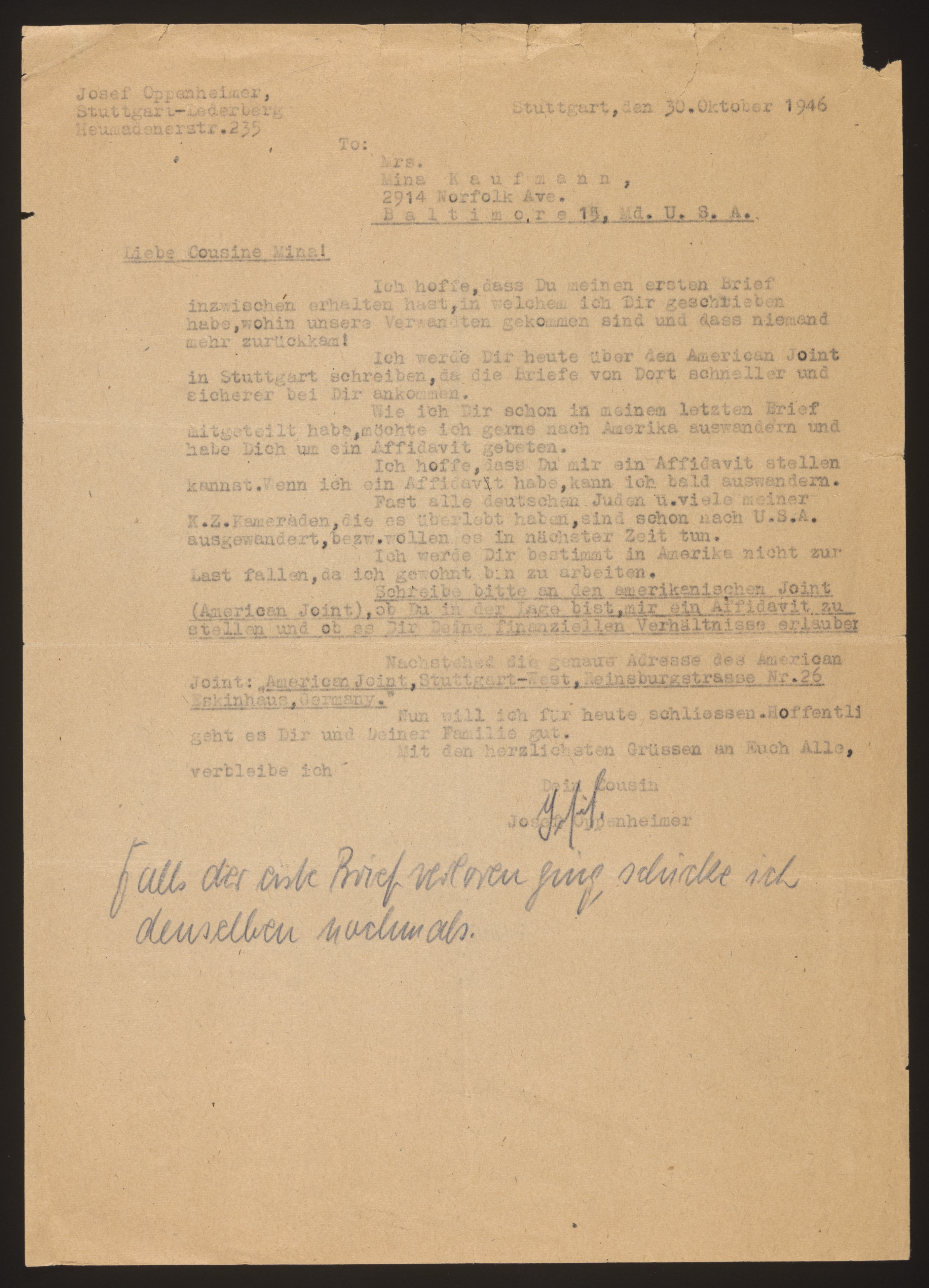
Typed letter to Mina Kaufmann requesting affidavit
30.10.1946
Transcribed
Josef Oppenheimer
Stuttgart-Lederberg
Neuwiesenstr. 239
Stuttgart, October 30, 1946
To:
Mrs.
Mina Kaufmann,
2914 Norfolk Ave.
Baltimore 15, Md. U.S.A.
Dear Cousin Mina!
I hope that you have received my first letter in the meantime, in which I wrote to you about where our relatives ended up and that no one came back!
I am writing to you today through the American Joint [Distribution Committee] in Stuttgart, as the letters arrive faster and more safely from there.
As I already told you in my last letter, I would like to emigrate to America and have asked you for an affidavit.
I hope that you can provide me with an affidavit. If I have an affidavit, I can emigrate soon. Almost all German Jews and many of my concentration camp comrades who survived have already emigrated to the U.S.A., or intend to do so in the near future.
I will certainly not be a burden to you in America, as I am used to working.
Please write to the American Joint (American Joint Distribution Committee) whether you are in a position to provide me with an affidavit and whether your financial circumstances allow it.
Below is the exact address of the American Joint: American Joint, Stuttgart-West, Reinsburgstrasse Nr. 26, Waihinhaus, Germany.
Now I want to close for today. I hope you and your family are well.
With the warmest regards to all of you,
I remain
Your cousin
Jo. [Josef] Oppenheimer
[Handwritten postscript:]
In case the first letter was lost, I am sending it again.
Josef Oppenheimer
Stuttgart-Lederberg
Neuwiesenstr. 239
Stuttgart, den 30. Oktober 1946
To:
Mrs.
Mina Kaufmann,
2914 Norfolk Ave.
Baltimore 15, Md. U.S.A.
Liebe Cousine Mina!
Ich hoffe, dass Du meinen ersten Brief inzwischen erhalten hast, in welchem ich Dir geschrieben habe, wohin unsere Verwandten gekommen sind und dass niemand mehr zuruckkam!
Ich werde Dir heute uber den American Joint in Stuttgart schreiben, da die Briefe von dort schneller und sicherer bei Dir ankommen.
Wie ich Dir schon in meinem letzten Brief mitgeteilt habe, mochte ich gerne nach Amerika auswandern und habe Dich um ein Affidavit gebeten.
Ich hoffe, dass Du mir ein Affidavit stellen kannst. Wenn ich ein Affidavit habe, kann ich bald auswandern. Fast alle deutschen Juden u. viele meiner K.Z. Kameraden, die es uberlebt haben, sind schon nach U.S.A. ausgewandert, bezw. wollen es in nachster Zeit tun.
Ich werde Dir bestimmt in Amerika nicht zur Last fallen, da ich gewohnt bin zu arbeiten.
Schreibe bitte an den amerikanischen Joint (American Joint), ob Du in der Lage bist, mir ein Affidavit zu stellen und ob es Dir Deine finanziellen Verhaltnisse erlauben.
Nachstehend die genaue Adresse des American Joint: American Joint, Stuttgart-West, Reinsburgstrasse Nr. 26, Waihinhaus, Germany.
Nun will ich fur heute schliessen. Hoffentlich geht es Dir und Deiner Familie gut.
Mit den herzlichsten Grussen an Euch Alle,
verbleibe ich
Dein Cousin
Jo. Oppenheimer
[Handwritten postscript:]
Falls der erste Brief verloren ging schicke ich denselben nochmals.
Josef Oppenheimer (born 1924) was the son of Moses Oppenheimer. After surviving Theresienstadt concentration camp and subsequent imprisonment, he wrote this typed letter to his cousin Mina Kaufmann in Baltimore, requesting an affidavit (sponsorship document) to emigrate to the United States. The letter was sent via the American Jewish Joint Distribution Committee (JDC/"Joint") office in Stuttgart, which assisted Holocaust survivors with mail and emigration. Josef eventually emigrated to Florida on August 17, 1949.
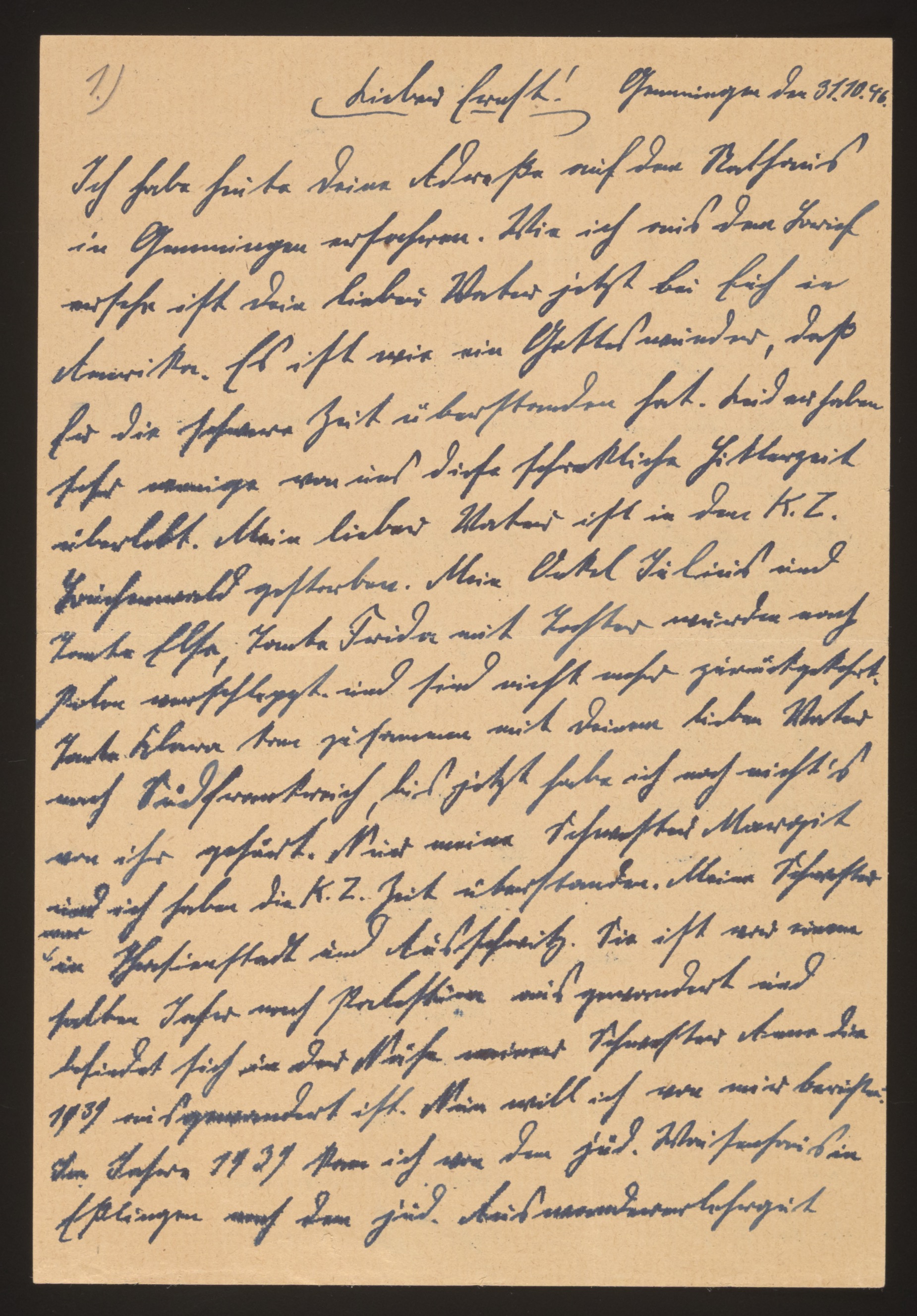
Handwritten letter to cousin — family fate (page 1 of 3)
30.10.1946
Transcribed
1)
Dear Cousin! Gemmingen, October 30, 1946
I found your address earlier at the town hall in Gemmingen. As I begin this letter -- your dear mother is after all in America. It is a miracle from God to me that you survived the terrible times. But very few of us survived this dreadful catastrophe. My dear father died in KZ Buchenwald concentration camp. My Uncle Julius and Aunt Elsa, Aunt Frieda and their children were deported and never returned. Aunt Klara was together with your dear father at Burkenbrausch [?] and I went to look for many things. Only my sister Margrit [Margit] and I survived the concentration camp period. My sister worked as a gardener and in a wood factory. She emigrated to Palestine half a year ago and is near a settlement that was established in 1939. Now I will report about myself: At the beginning of 1939, I was at the Jewish emigration training estate in Esslingen, then at the Jewish emigration training farm at
[continues on page 2]
1)
Liebe Cousine! Gemmingen den 30.10.46
Ich habe fruher Deine Adresse auf dem Rathaus in Gemmingen aufgefunden. Als ich mit dem Brief anfange, ich Deine liebe Mutter geht doch bis in Amerika. Es ist mir ein Gotterwunder, dass Du die schwere Zeit uberstanden hast. Doch auf haben sehr wenige von uns diese schreckliche Katastrophe uberlebt. Mein lieber Vater ist in dem K.Z. Buchenwald gestorben. Mein Onkel Julius und Tante Elsa, Tante Frieda und deren Kinder sind verschleppt und sind nicht mehr zuruckgekehrt. Tante Klara war zusammen mit Deinem lieben Vater nach Burkenbrausch [?] und gehe ich habe ich auf vieles [?] war es gespaht. Nur meine Schwester Margrit und ich haben die K.Z. Zeit uberstanden. Meine Schwester war ein Gartnerin und Holzfabrik. Sie ist von einem halben Jahre nach Palastina mit ausgewandert und befindet sich in der Nahe von einer Ortschaft nanntes [?] die 1939 mit zusammengebaut ist. Mein, will ich von mir berichten: Anfang 1939 war ich von den jud. Auswanderunglehrgut in Esslingen auf dem jud. Auswanderungslehrgut
This is the first page of a 3-page handwritten letter from Josef Oppenheimer, written on the same date as the typed letter (October 30, 1946) but apparently a more personal, detailed account. He provides crucial family information: his father Moses Oppenheimer died at KZ Buchenwald, Uncle Julius and Aunt Elsa Oppenheimer were deported and did not return, Aunt Frieda and her children were deported and did not return, Aunt Klara (Kaufmann, nee Oppenheimer) is mentioned in connection with the recipient's father. Only Josef and his sister Margit survived the camps. Margit had emigrated to Palestine about half a year before (around early 1946). Josef had been at Jewish emigration training farms (Hachshara) in Esslingen and then Grossbreesen near Breslau.
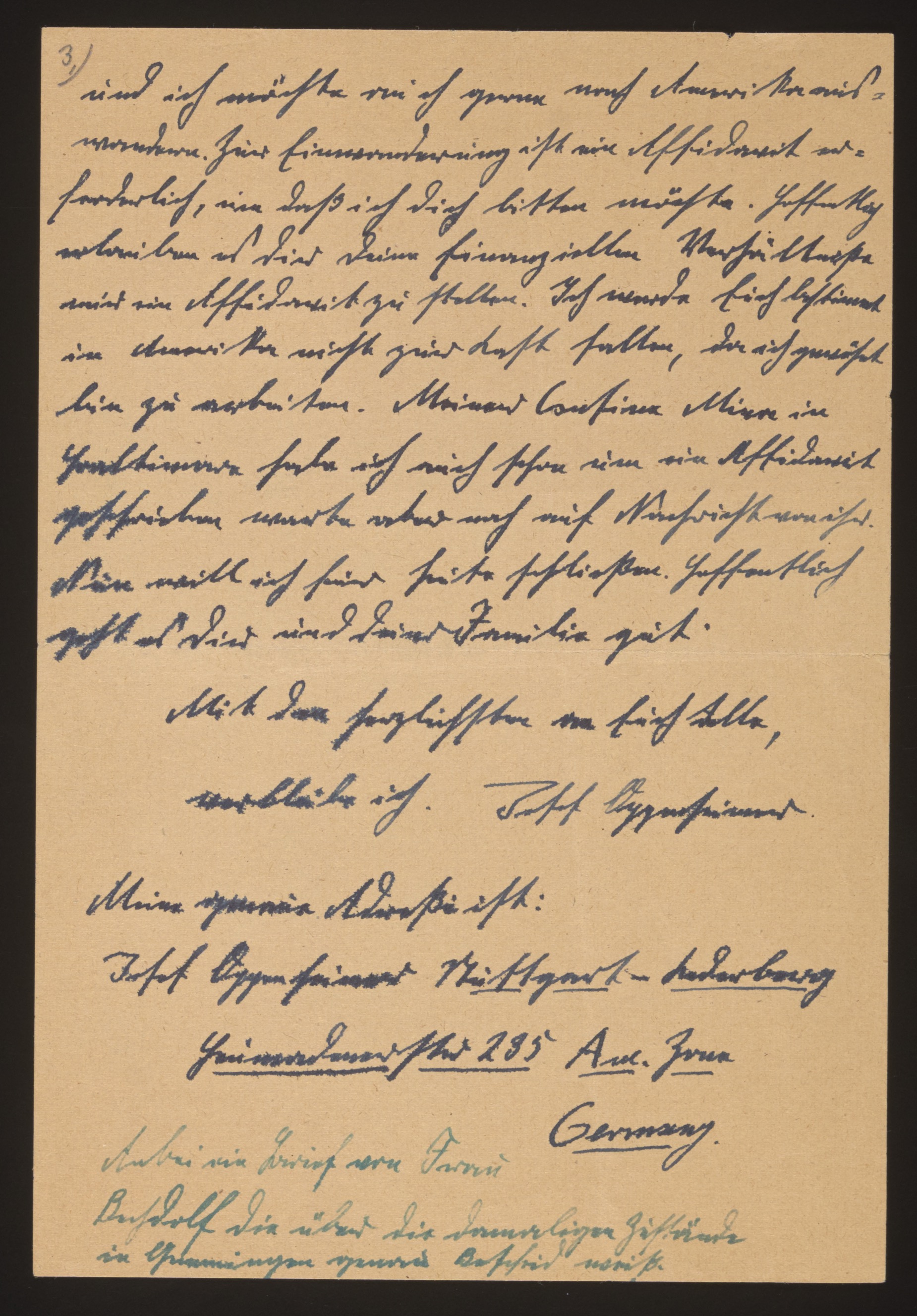
Handwritten letter to cousin — emigration request (page 3 of 3)
30.10.1946
Transcribed
3)
and I would like to emigrate to America. For immigration, an affidavit or food package is needed, and I would like to ask you for this. Apparently your financial means would allow you to provide me with an affidavit. I would not be a burden in America, as I am used to working. I have also already written to my cousin Mina in Franklinton asking for an affidavit, but am still waiting for word from her. Now I want to close for today. I hope you and your family are well.
With the warmest regards to all of you,
I remain. Josef Oppenheimer.
My exact address is:
Josef Oppenheimer, Stuttgart-Lederberg
Neuwiesenstrasse 239, American Zone
Germany
[Handwritten postscript:]
Enclosed is a letter about the previous Jewish history in Gemmingen; please also ask Cousin Sophie to write.
3)
und ich mochte wie ich gerne nach Amerika auswandern. Zur Einwanderung ist ein Affidavit oder Foodpaket, und dass ich Dich bitten mochte. Offenbar existieren auf Dir Deine finanziellen Moglichkeiten, mir ein Affidavit zu stellen. Ich werde in Amerika nicht gut doch halten, der ich gewohnt bin zu arbeiten. Meiner Cousine Mina in Franklinton habe ich auch schon einen Affidavit geschrieben, warte aber noch auf Nachricht von ihr. Nun will ich hier heute schliessen. Hoffentlich geht es Dir und Deiner Familie gut.
Mit den herzlichsten an Euch Alle,
verbleibe ich. Josef Oppenheimer.
Meine genaue Adresse ist:
Josef Oppenheimer, Stuttgart-Lederberg
Neuwiesenstrasse 239, Am. Zone
Germany
[Handwritten postscript:]
Anbei ein Brief uber die bisherigen judische Geschichte in Gemmingen, spreche Cousine Sophie auch zu schreiben.
The final page of Josef's handwritten letter reveals his strong desire to emigrate to America, his need for an affidavit or food packages, that he had written to another cousin Mina in Franklinton as well, and mentions a Cousin Sophie. His address was Stuttgart-Lederberg, Neuwiesenstrasse 239, in the American Occupation Zone. He enclosed a document about Jewish history in Gemmingen. Josef eventually succeeded in emigrating to Florida on August 17, 1949.
Notes
Cousin in America
Recipient of Josef's letters (1946) and Margit's letter (1939)
Possible daughter of Klara Kaufmann
Josef also mentions 'Cousin Mina in Franklinton' — possibly a different person (Franklinton, NC or LA)
Addressed as 'Dr. Mina Kaufmann' on all correspondence envelopes. Moved from New York to Baltimore c. early 1941 (Elsa's Jan 1941 letter confirms).
Earlier Baltimore address: 4006 Norfolk Ave. (c/o Engel or c/o Heller, per different envelopes). Later: 2914 Norfolk Ave.
Sources
Oppenheimer/Shacham Family ArchiveUSHMM Kaufmann Family Correspondence