Karl Maier sends packages to Margit in Theresienstadt
Baker in Solnstitting near Landsberg, Bavaria. Addressed as "Uncle Karl" by Margit. Sent food packages to the concentration camp — an act of courage. 📍 Solnstitting
Correspondence (8 documents)
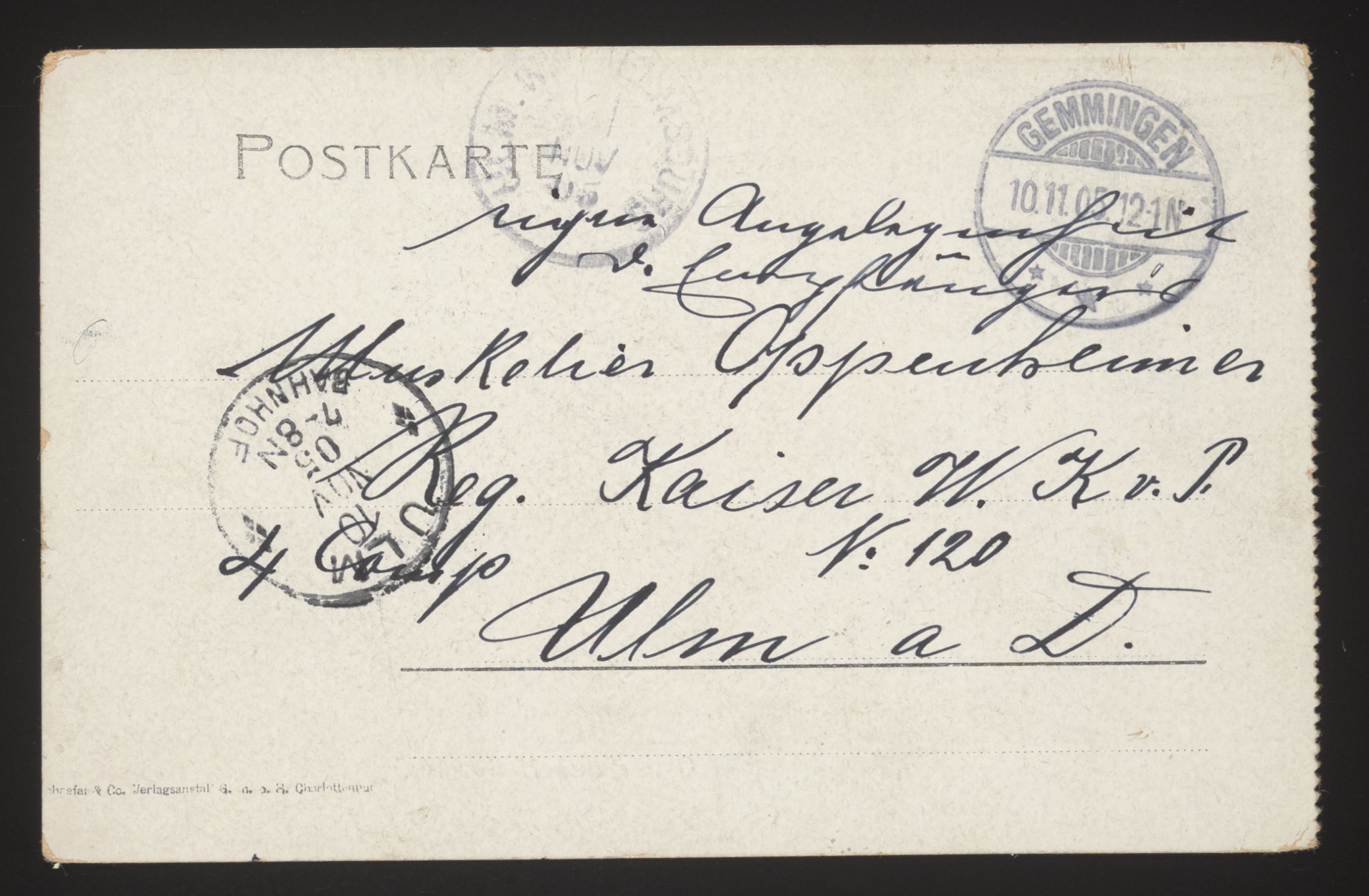
Picture postcard back (address side)
1900
Transcribed
Address side of postcard. Printed heading "Postkarte" at top. Postmark visible from Heilbronn [date partially legible]. Addressed in handwritten Kurrent script to:
Fräulein Angela [?] Oppenheimer
[c/o?] Kaiser W. Karl [?]
Ulm a. D. [Ulm an der Donau]
None
None
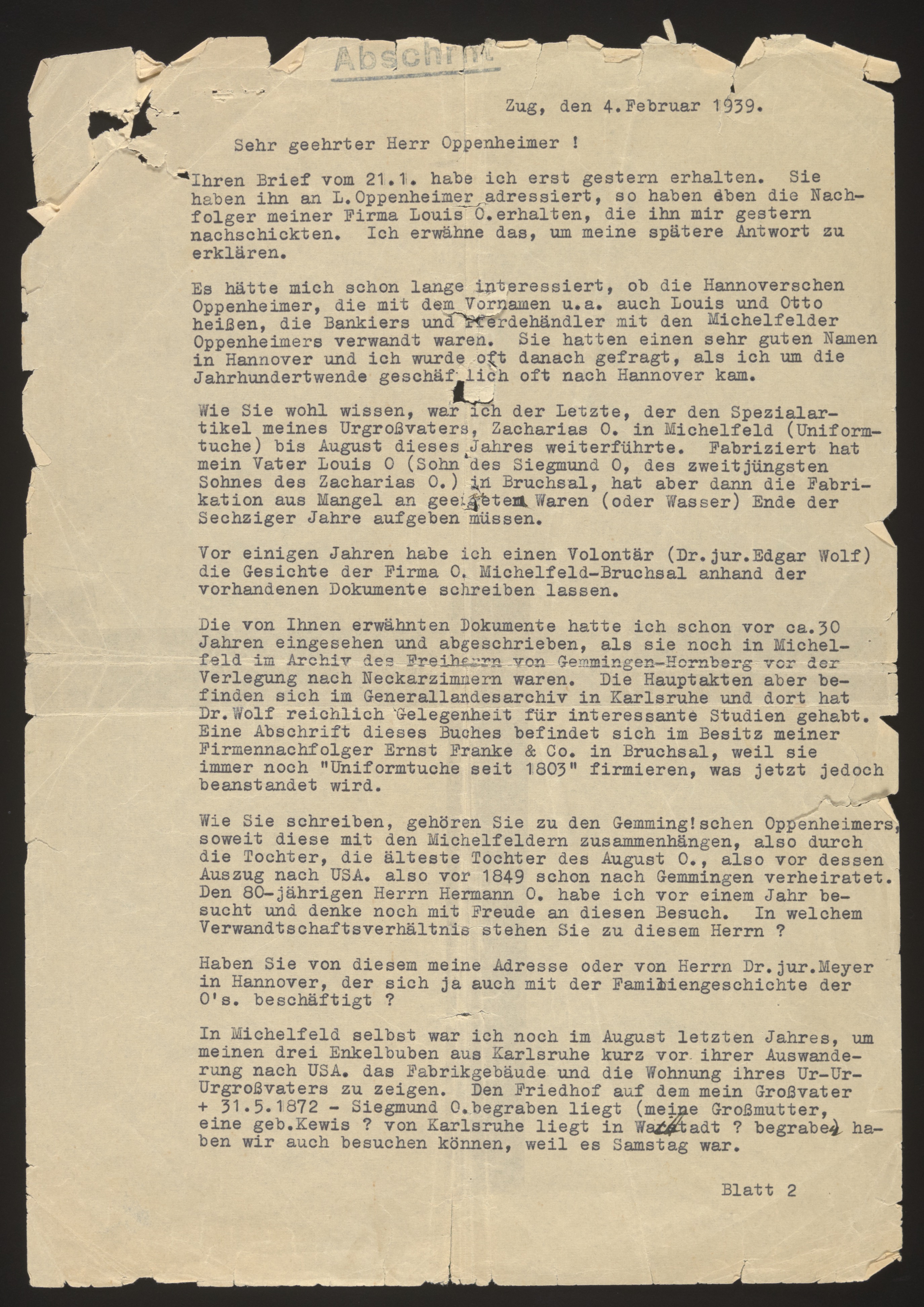
Typed letter (page 1 of 2), marked "Abschrift" (copy)
04.02.1939
Transcribed
Copy
Zug, February 4, 1939.
Dear Mr. Oppenheimer!
I only received your letter of January 21 yesterday. You addressed it to L. Oppenheimer, so the successors of my firm Louis C. [Oppenheimer] received it and forwarded it to me yesterday. I take the liberty of responding to your inquiry.
I have long been interested in whether the Hanover Oppenheimers — as the first names Louis and Otto also suggest — the bankers and cattle dealers, were related to the Michelfeld Oppenheimers. They had a very good name in Hanover and I was often asked about this when I frequently traveled to Hanover on business around the turn of the century.
As you probably know, I was the last one to continue the specialty product of my great-grandfather, Zacharias O. in Michelfeld (Lower Franconia) until August of this year. In fact, my father Louis O. (son of Sigmund O., the second-youngest son of Zacharias O.) was in Bruchsal, but had to give up the manufacturing due to a lack of suitable materials (or water) at the end of the 1860s.
A few years ago, I had a volunteer (Dr. jur. Edgar Wolf) write the history of the firm O. Michelfeld-Bruchsal based on the available documents.
The documents you mentioned, I examined and copied about 30 years ago, when they were still in Michelfeld in the archive of the Freiherren [Barons] von Gemmingen, before their transfer to Neckarelz. However, the main files are in the General State Archive in Karlsruhe, and there Dr. Wolf had ample opportunity for interesting studies. A copy of this book is in the possession of my firm's successors, Ernst Franke & Co. in Bruchsal, because we still trade under the name "Uniform Cloth since 1803," which is now being challenged.
As you write, you belong to the Gemmingen Oppenheimers, insofar as they are connected with the Michelfeld branch — that is, through the eldest daughter of August O., who was already married into Gemmingen before his departure for the USA, that is, before 1845. I visited the 80-year-old Mr. Hermann O. a year ago and still think fondly of that visit. What is your family relationship to this gentleman?
Did you get my address from him or from Dr. jur. Meyer in Hanover, who is also occupied with the family history of the O[ppenheimer]s?
I was still in Michelfeld itself last August, to show my three grandsons from Karlsruhe — shortly before their emigration to the USA — the factory building and the residence of their great-great-great-grandfather. We were also able to visit the cemetery where my grandfather — died May 31, 1872 — Sigmund O. is buried (my grandmother, née Levi? from Karlsruhe, is buried in Waghäusel?), because it was a Saturday.
Sheet 2
Abschrift
Zug, den 4. Februar 1939.
Sehr geehrter Herr Oppenheimer!
Ihren Brief vom 21.1. habe ich erst gestern erhalten. Sie haben ihn an L. Oppenheimer adressiert, so haben also die Nachfolger meiner Firma Louis C. erhalten, die ihn mir gestern nachzuschicken. Ich erlaube mir, auf Ihre spätere Anfrage zu erklären.
Es hätte mich schon lange interessiert, ob die Hannoverschen Oppenheimer, wie als die Vornamen das auch Louis und Otto besagen, die Bankiers und Viehhändler mit den Michelfelder Oppenheimer verwandt waren. Die hatten einen sehr guten Namen in Hannover und ich wurde oft danach gefragt, als ich um die Jahrhundertwende geschäftl. ich oft nach Hannover kam.
Wie Sie wohl wissen, war ich der Letzte, der den Spezialartikel meines Urgrossvaters, Sacharias O. in Michelfeld (Unterfranken) im August dieses Jahres weiterführte. Tatsächlich hat mein Vater Louis O. (Sohn des Sigmund O., des zweitjüngsten Sohnes des Sacharias O.) in Bruchsal, hat aber diese die Fabrikation aus Mangel an geeigneten Waren (oder Wasser) Ende der Sechziger Jahre aufgeben müssen.
Vor einigen Jahren habe ich einen Volontär (Dr. jur. Edgar Wolf) die Gesichte der Firma O. Michelfeld-Bruchsal anhand der vorhandenen Dokumente schreiben lassen.
Die von Ihnen erwähnten Dokumente habe ich vor ca. 30 Jahren eingesehen und abgeschrieben, als sie noch in Michelfeld im Archiv der Freiherren von Gemmingen zur Verfügung nach Neckarelz waren. Die Hauptakten aber befinden sich in Generallandesarchiv in Karlsruhe und dort hat Dr. Wolf reichlich Gelegenheit für interessante Studien gehabt. Eine Abschrift dieses Buches befindet sich im Besitz meiner Firmennachfolger Ernst Franke & Co. in Bruchsal, weil wir unser noch "Uniformtuche seit 1803" firmieren, was jetzt doch beanstandet wird.
Wie Sie schreiben, gehören Sie zu den Gemmingschen Oppenheimern, soweit diese mit den Michelfeldern zusammenhängen, also durch die älteste Tochter des August O., also vor dessen Auszug nach USA, also vor 1845 schon nach Gemmingen verheiratet. Den 80-jährigen Herrn Hermann O. habe ich vor einem Jahr besucht und danke noch mit Freude an diesen Besuch. In welchem Verwandtschaftsverhältnis stehen Sie zu diesem Herrn?
Haben Sie von diesem meine Adresse oder von Herrn Dr. jur. Meyer in Hannover, der sich ja auch mit der Familiengeschichte der O. beschäftigt?
In Michelfeld selbst war ich noch im August letzten Jahres, um meinen drei Enkelbuben aus Karlsruhe kurz vor ihrer Auswanderung nach USA. das Fabrikgebäude und die Wohnung ihres Ur-Ur-Urgrossvaters zu zeigen. Den Friedhof auf dem mein Grossvater + 31.5.1872 — Sigmund O. begraben liegt (meine Grossmutter, eine geb. Levi? von Karlsruhe liegt in Waghäusel?) begraben haben wir auch besuchen können, weil es Samstag war.
Blatt 2
Otto Oppenheimer was a textile manufacturer in Bruchsal, Germany, descended from the Michelfeld branch of the Oppenheimer family. His great-grandfather Zacharias Oppenheimer had established a cloth manufacturing business in Michelfeld (Lower Franconia). By February 1939, Otto had already relocated to Zug, Switzerland, likely fleeing Nazi persecution. This letter responds to a genealogical inquiry from another Oppenheimer, possibly from the Hanover branch. Otto discusses the family's connections across Michelfeld, Gemmingen, Bruchsal, and Hanover, and mentions his grandsons' recent emigration to the USA. The letter reveals a family deeply aware of its history even as it faced displacement and persecution. The firm "Uniformtuche seit 1803" (Uniform Cloth since 1803) was a significant textile enterprise.
Handwritten letter
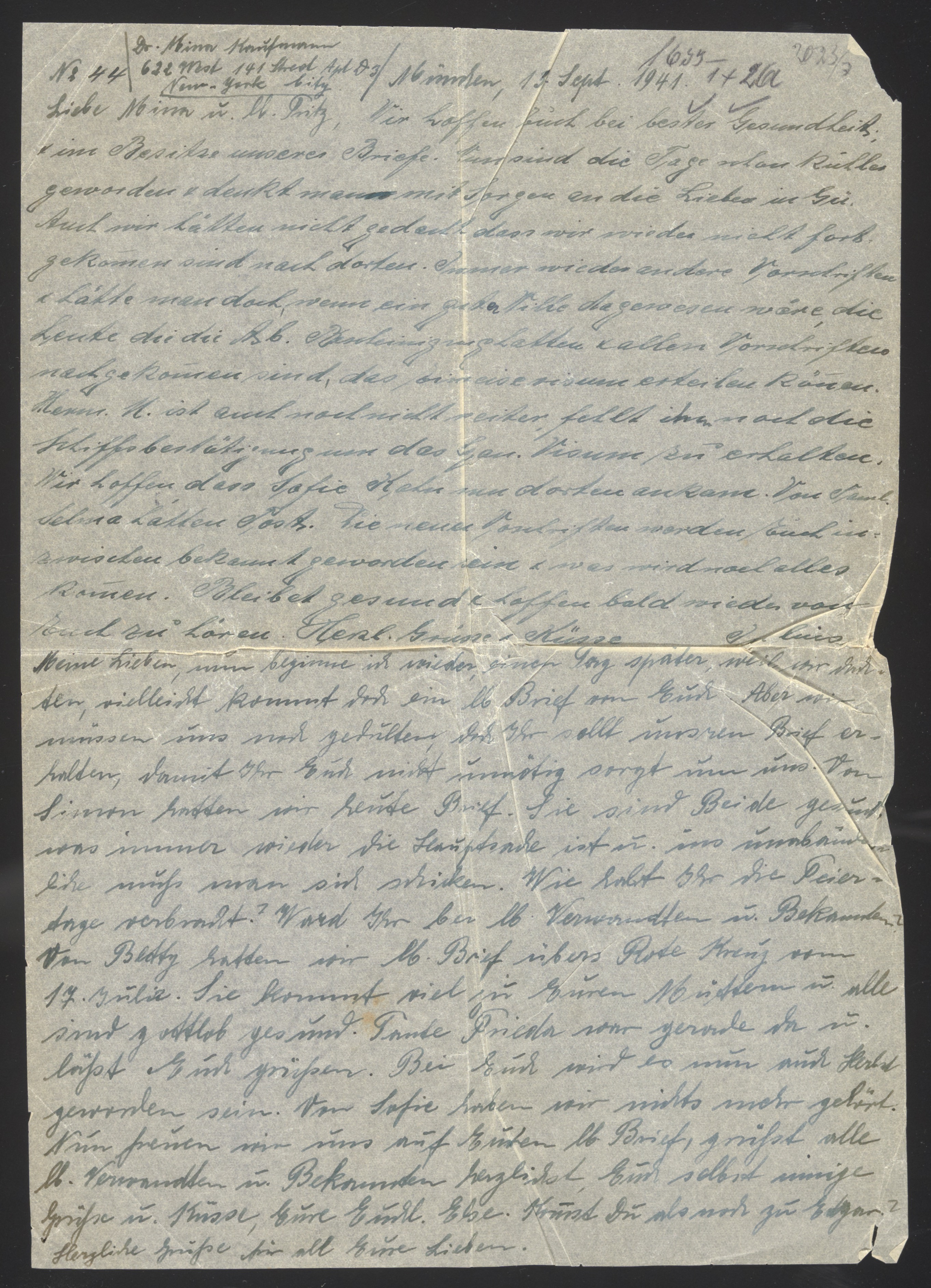
15.09.1941
Transcribed
Munich, September 15, 1941
Dear Mina and dear [family],
[The letter discusses receiving correspondence on Saturdays, references to ongoing matters with various relatives, mentions Bella, emigration efforts, Holland, and Karl. The writer updates Mina on family news and the increasingly difficult situation.]
Dr. Mina Kaufmann
[?] Abt. [?] Brief; [?] München 15 Sept. 1941 [?] [?]
Liebe Mina u. lb. [?]
Es köpfen [?] uns liebe Samstäglich kam also [?] [?] Briefe manches [?] allerdings [?] manns noch fragen es [?] die lieber es [?] hat nur [?] nicht Alles gehennen [?] und noch Adern [?] mir wieder andere Verwandter [?] u. als stellt [?] auch und diese grosse Bitte alle [?] zusammen welches bei der [?] des 1.V. [?] [Auswanderung?] [?] das Gebiet an Bella in [?] die im [?] wurde [?] und Alberts [?] seid kommen also [?] dazu [?] Gescheiten [?] ...
[Multiple paragraphs continuing in Kurrent — mentions Betty, Holland, emigration, Karl]
Written just four days before the mandatory wearing of the Yellow Star was enforced (September 19, 1941), this letter reflects the last weeks before the most visible marker of persecution was imposed on German Jews. The references to emigration at this late date show that some still held out hope, even as exit routes had largely closed.
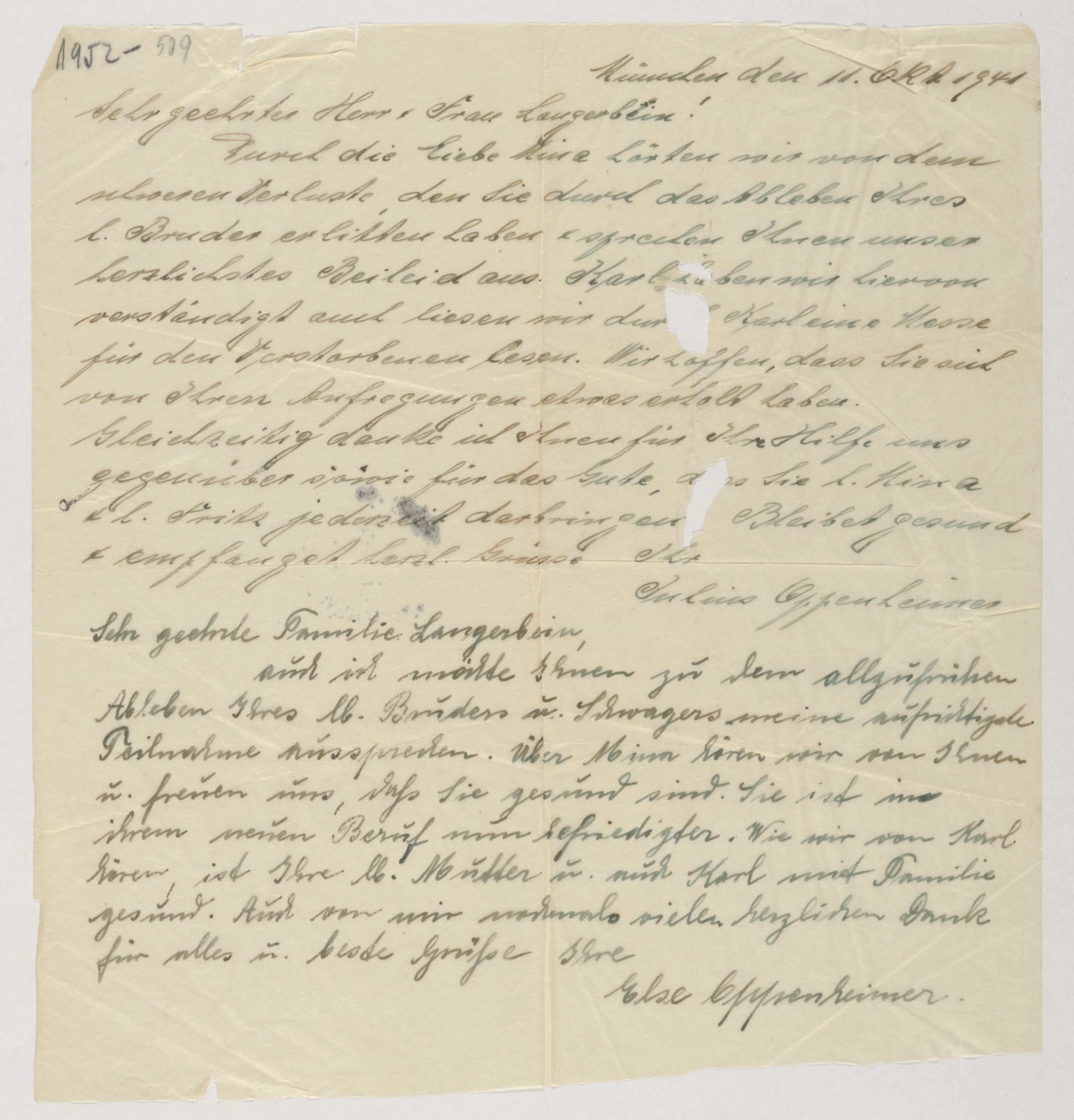
Handwritten letter — two separate notes: a condolence letter and a personal note
11.10.1941
Transcribed
[First section:]
Munich, October 11, 1941
Dear Mr. and Mrs. Langstein!
Through dear Mina, we learned of the untimely passing of your dear brother and beloved [relative], and we express our most heartfelt condolences. At the same time, we have been informed and have arranged through Mr. Herre to have [prayers] read for the deceased. We hope that you have somewhat recovered from your grief.
At the same time, I thank you for your help toward me... for the good that you and dear Mina [have done]... a package was sent and received...
Julius Oppenheimer
[Second section:]
Dear Langstein family,
I too would like to express my sincere condolences on the untimely passing of your dear brother and brother-in-law. Through Mina here we hear from you and are glad that you are healthy. She is very content in her new profession. As we hear from Karl here, your dear mother and Karl and family are also healthy. And from me once again many heartfelt thanks for everything.
With warm greetings, yours,
Elsa Oppenheimer
[First section:]
München den 11. Okt. 1941
Sehr geehrter Herr u. Frau Langstein!
Durch die liebe Mina liessen mir von dem allzufrühen Ableben Ihres lb. Bruders u. lieben Landes u. sprechen Ihnen unsere herzlichste Beileid aus. Gleichzeitig sind wir hiervor verständigt und lassen wir durch Herrn Herre für den Verstorbenen lesen. Wir hoffen, dass Sie viel von Ihrem Aufzügernen etwas erholt haben.
Gleichzeitig danke ich Ihnen für [?] Ihre Hilfe mich gegenüber [?] für das Gute, das Sie lb. Mina u. [?] Seide [?] doch ist das bringt [?] Paket [?] gesand u. empfangen [?] Grüsst [?]
Julius Oppenheimer
[Second section:]
Sehr geehrte Familie Langstein,
auch ich möchte Ihnen zu dem allzufrühen Ableben Ihres lb. Bruders u. Schwagers meine aufrichtige Beilnahme aussprechen. Über Mina hier können wir von Ihnen u. freuen uns, dass Sie gesund sind. Sie ist in ihrem neuen Beruf [?] sehr zufrieden. Wie mir von Karl hier, ist Ihre lb. Mutter u. auch Karl mit Familie gesund. Und von mir nochmals vielen herzlichen Dank für alles Eins. Liebe Grüsse Ihre
Elsa Oppenheimer
This condolence letter from Julius and Elsa Oppenheimer to the Langstein family, written just weeks before the mass deportations began, reveals the family's continued adherence to social customs and human kindness even under extreme persecution. The mention of Mina's "new profession" (neuer Beruf) may indicate she had found work in America. Karl appears to be a family member still in the Munich area. Julius and Elsa write from Ainmillerstrasse 19/II in Munich, where they were confined.
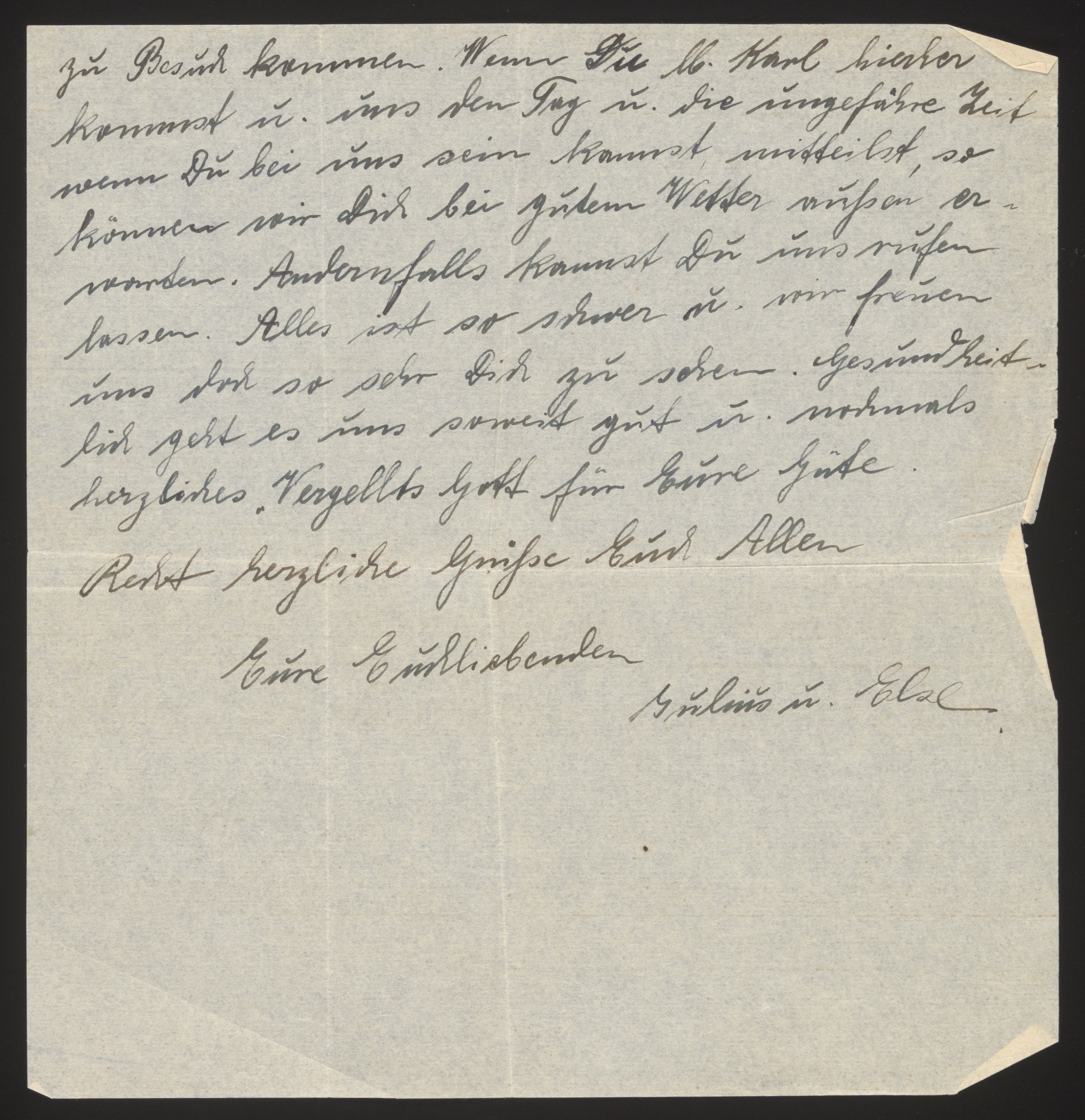
Handwritten letter (page 2 of 2, continuation of 0023)
27.03.1942
Transcribed
come to visit. If dear Karl comes here, and lets us know the day and approximate time when you can be with us, we can meet you outside in good weather. Otherwise, you can have us called. Everything is so difficult, and yet we are so very glad to see you well. Health-wise, we are doing fairly well, and once again a heartfelt "God reward you" for your gift.
Warmest greetings to you all,
Your loving
Julius and Elsa
None
This continuation reveals the severe restrictions on Julius and Elsa's daily life. They must be notified in advance of visits and can only meet visitors "outside" (draussen) — suggesting they are confined to a building and need special arrangements to receive guests. The "Bezirksverbot" (district ban) mentioned on the previous page means they cannot leave their designated area. Karl appears to be a relative still able to visit them in Munich. Despite everything, the letter maintains a tone of warmth and gratitude, closing with the deeply Bavarian expression "Vergelt's Gott" (May God reward you). This was written less than five months before their letter of July 18, 1942 (image 0022), after which no further correspondence appears in the collection.
Handwritten short letter/note
18.07.1942
Transcribed
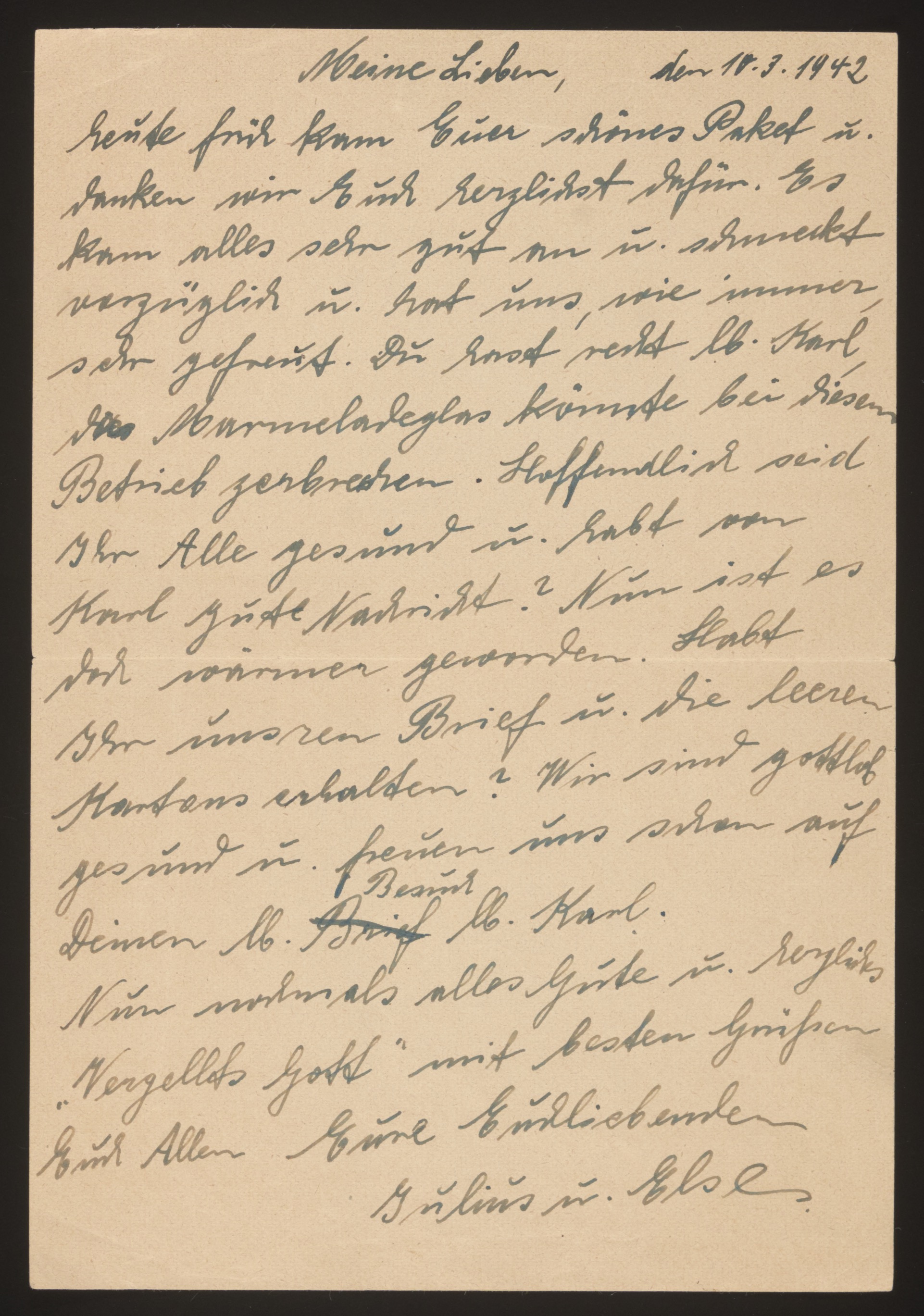
My dear ones, July 18, 1942
This morning your beautiful package arrived, and we thank you most warmly for it. Everything arrived in very good condition and tastes excellent, and it made us very happy, as always. You are right, dear Karl — the jam jar could [not survive] this shipping [process] without breaking. Hopefully you are all well and have good news from Karl? It has now gotten warmer. Did you receive our letter and the empty cartons? We are, thank God, healthy and already look forward to your dear letter, dear Karl.
Once again, all the best and may God reward you, with best greetings to all of you, your loving
Julius and Elsa
None
This brief but deeply poignant letter, dated July 18, 1942, is one of the latest documents in this collection. By this date, the systematic deportation and murder of Munich's Jews was well underway. The first deportation from Munich to Kaunas occurred on November 20, 1941, followed by transports to Piaski (April 1942), Theresienstadt, and Auschwitz. That Julius and Elsa were still able to write in July 1942 suggests they had not yet been deported. The letter's mundane discussion of packages, jam jars, and weather stands in stark contrast to the horror surrounding them. The phrase "Vergelt's Gott" (May God reward you) is a traditional Bavarian/Southern German expression of deep gratitude. This letter represents the Oppenheimers clinging to normalcy and family connection in the face of impending catastrophe.
Theresienstadt camp postcard — message side
19.06.1944
Transcribed
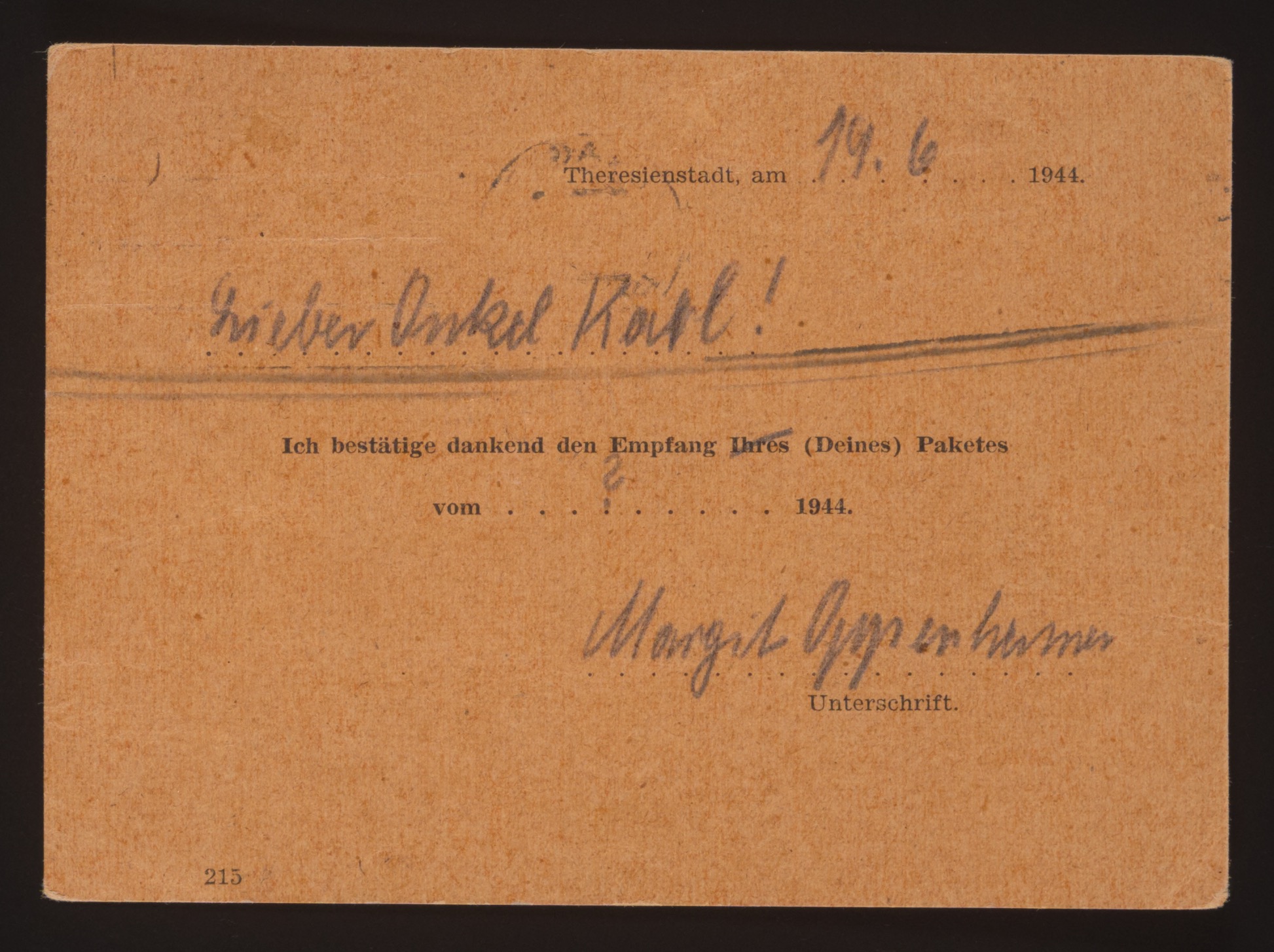
Theresienstadt, June 19, 1944.
Dear Uncle Karl!
I gratefully acknowledge receipt of your package
from . . . . . . . . 1944.
Margit Oppenheimer
Signature.
[Pre-printed form number: 215]
Theresienstadt, am 19. 6. 1944.
Lieber Onkel Karl!
Ich bestatige dankend den Empfang Ihres (Deines) Paketes
vom . . . . . . . . 1944.
Margit Oppenheimer
Unterschrift.
[Pre-printed form number: 215]
This is a pre-printed postcard form used in Theresienstadt concentration camp/ghetto. Prisoners were given these standardized cards to confirm receipt of packages from the outside -- one of the few forms of communication permitted. Margit filled in 'Lieber Onkel Karl!' (Dear Uncle Karl!) and signed her name. The recipient was Karl Maier, a baker in Solnstitting near Landsberg, Bavaria. The date is June 19, 1944. Margit had been deported to Theresienstadt on April 2, 1943. She would later be transported to Auschwitz in October 1944. This card is a direct communication from inside Theresienstadt.
Theresienstadt camp postcard — address side
19.06.1944
Transcribed
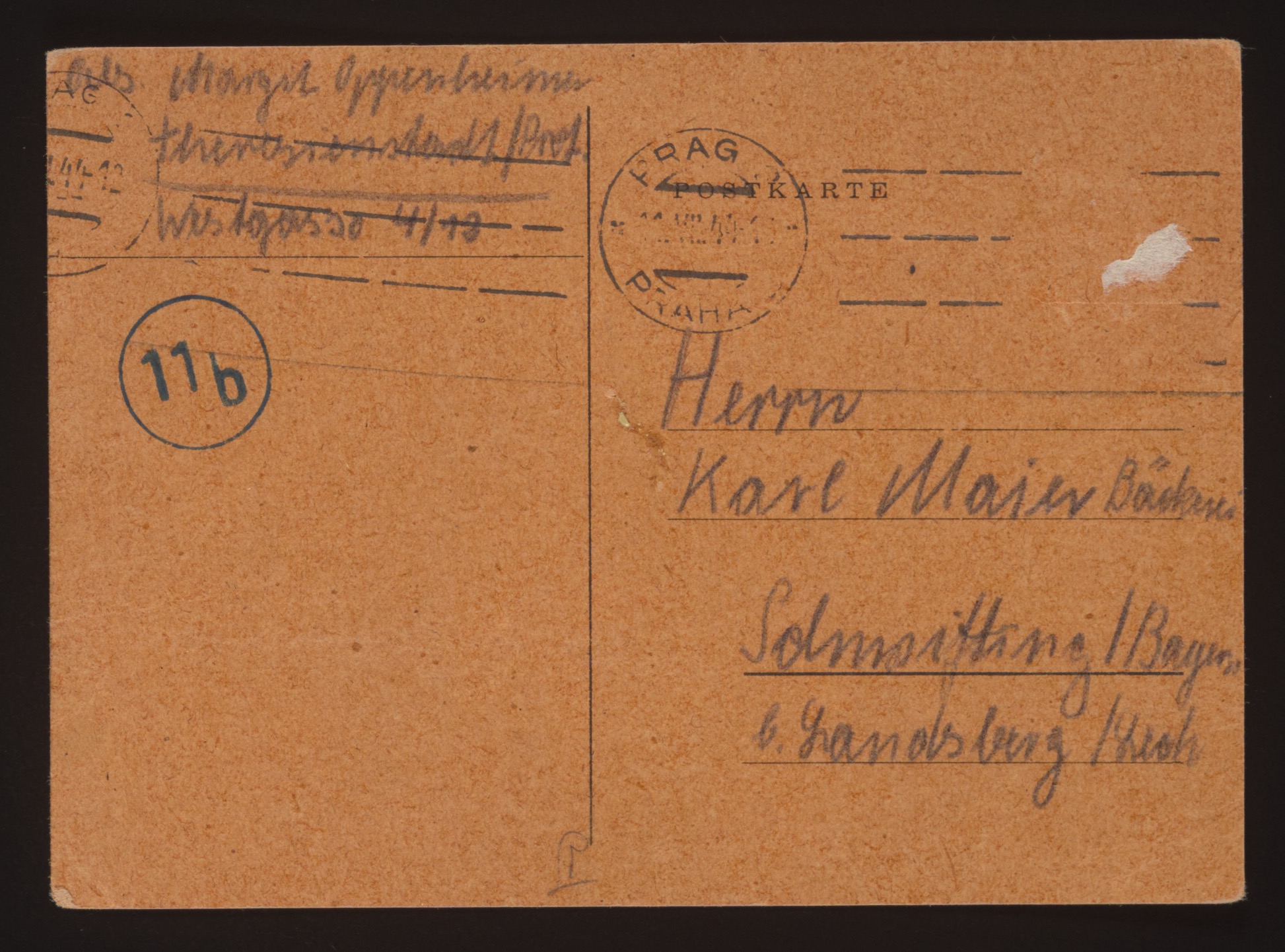
Sender: Margit Oppenheimer
Theresienstadt (Protectorate)
Ws. Logstr. 4/12
[Postmark: PRAGUE]
POSTCARD
To:
Mr. Karl Maier, Baker
Solnstitting / Bavaria
near Landsberg / Upper [Bavaria]
Abs: Margit Oppenheimer
Theresienstadt (Prot.)
Ws. Logstr. 4/12
[Postmark: PRAG / PRAHA]
POSTKARTE
[Postal zone marking: 11b]
Herrn
Karl Maier, Backer...
Solnstitting / Bayern
b. Landsberg / Hoch
This is the address side of the Theresienstadt postcard (front side is file 0003). Key details: Margit's camp address was Theresienstadt, in the Protectorate of Bohemia and Moravia (German-occupied Czechoslovakia), with barracks/lodging reference 'Ws. Logstr. 4/12'. The card was routed through Prague (PRAG/PRAHA postmark), as all camp mail was censored and processed through Prague. The recipient Karl Maier was a baker in Solnstitting near Landsberg in Upper Bavaria. He was addressed as 'Onkel Karl' on the front -- likely a family connection through marriage or an honorary uncle who sent food packages to Margit in the camp.
Notes
Margit's Theresienstadt postcard (19.06.1944) addressed to 'Dear Uncle Karl!'. Sent food packages to Margit in camp. Non-Jewish contact — act of courage during Nazi period.
Julius/Elsa's March 1942 letter: Karl visited them in Munich despite Bezirksverbot restrictions. Had to be notified of day and time in advance.
July 1942 letter: sent packages including jam (jar broke in shipping). 'Vergelt's Gott' — deep gratitude for continued support.